
coming
soon
coming
soon
coming
soon
coming
soon
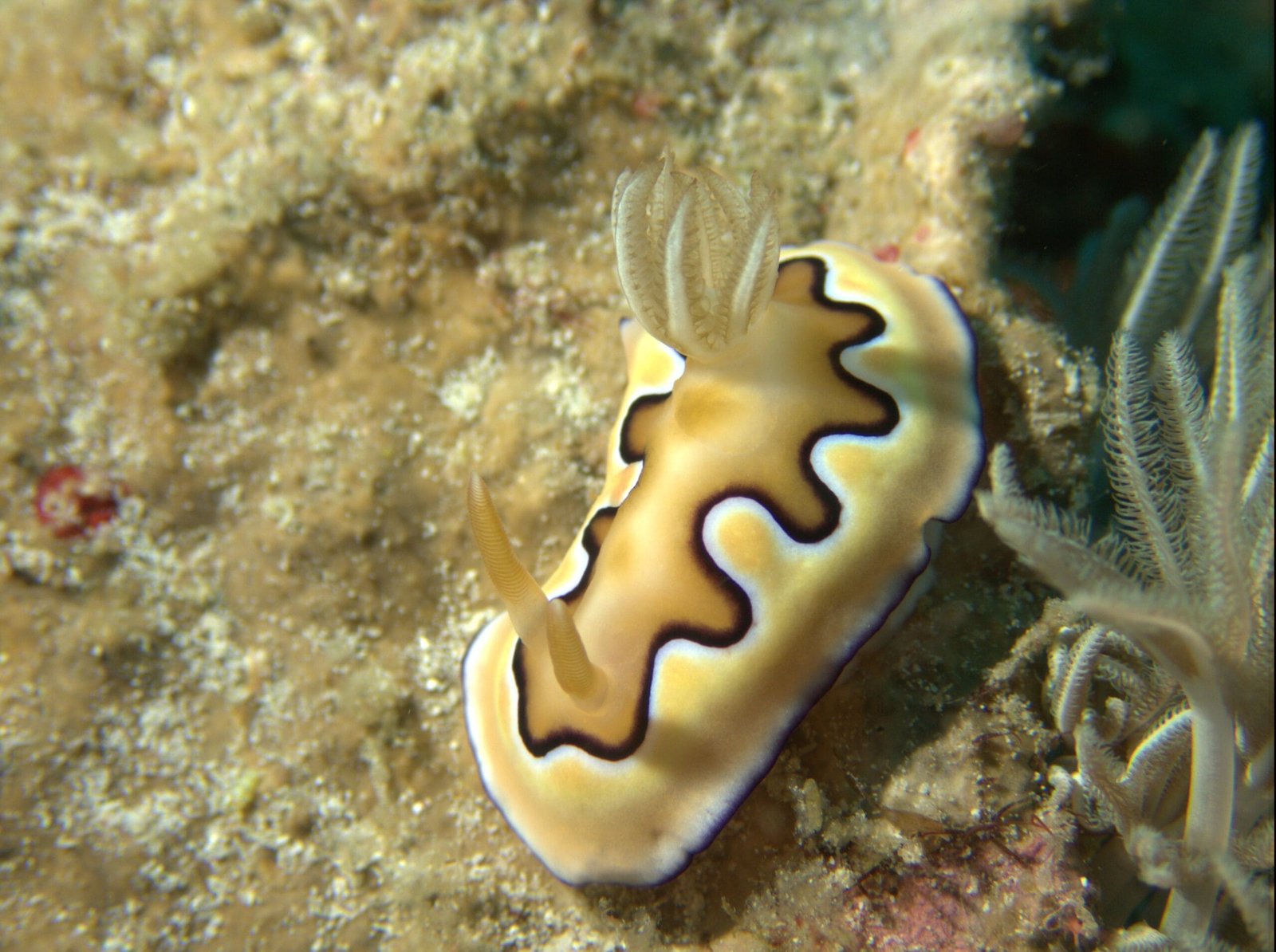
Goniobranchus coi is one of the most elegantly patterned nudibranchs in the Indo-Pacific. Risbec described it in 1956, and it has since become one of the classic macro photography subjects across the Philippines. It belongs to the genus Goniobranchus — a group of chromodorid nudibranchs separated from Chromodoris based on molecular and morphological work by Johnson and Gosliner in 2012. Finding it on a dive in Romblon is a rewarding encounter. It feeds on sponges and moves slowly across the reef, making it an ideal subject for macro underwater photography in Romblon.
Appearance and Identification
Goniobranchus coi has a white body with a broad orange-red mantle border. A row of purple or violet spots runs along the inner edge of the mantle border, just inside the orange band. The gills and rhinophores are orange to reddish-orange. Furthermore, small orange spots are often scattered across the white mantle surface. Adults typically reach 30–50mm in length. The combination of white body, orange mantle border, and purple inner spots is distinctive and separates it clearly from similar species such as Goniobranchus kuniei and Goniobranchus fidelis. In addition, the vivid colouration serves as a warning to predators — chromodorids sequester toxic compounds from their sponge prey.
Habitat and Biology
Goniobranchus coi feeds on encrusting sponges of the order Verongimorpha — the same group targeted by most chromodorid nudibranchs. It lives on reef slopes, rubble, and silty substrate at depths accessible on recreational dives. Like all chromodorids, it is a simultaneous hermaphrodite. Moreover, it deposits eggs in a characteristic spiral ribbon on the reef surface. Its range extends across the Indo-Pacific — from the Philippines and Indonesia through to the central Pacific. Consequently, Romblon sits well within its core distribution.
Diving with Goniobranchus coi in Romblon
Look for Goniobranchus coi on silty reef slopes and rubble areas where encrusting sponges are present — typically at 10–25 metres. Its bright orange mantle border makes it relatively easy to spot compared to more cryptically coloured nudibranchs. Therefore, it is an excellent species for beginner macro photographers. Photograph it from above and from the side to capture the full pattern detail. Submit your sighting to the iNaturalist taxon page to contribute to distribution mapping. Full taxonomy is available on the WoRMS species page.
| Suborder | Doridina (Dorid Nudibranchs) |
|---|---|
| Family | Chromodorididae |
| Genus | Goniobranchus |
| WoRMS AphiaID | 597329 |
| iNaturalist | 481507 |
| Identifying Features | White body with broad orange-red mantle border. Row of purple/violet spots along inner mantle border. Orange gills and rhinophores. Small orange spots on white mantle. Adults 30-50mm. Distinguished from G. kuniei and G. fidelis by purple inner spot row. |
|---|
| Substrate | Reef slopes, silty rubble, encrusting sponge |
|---|