
coming
soon
coming
soon
coming
soon
coming
soon
Identification and Appearance
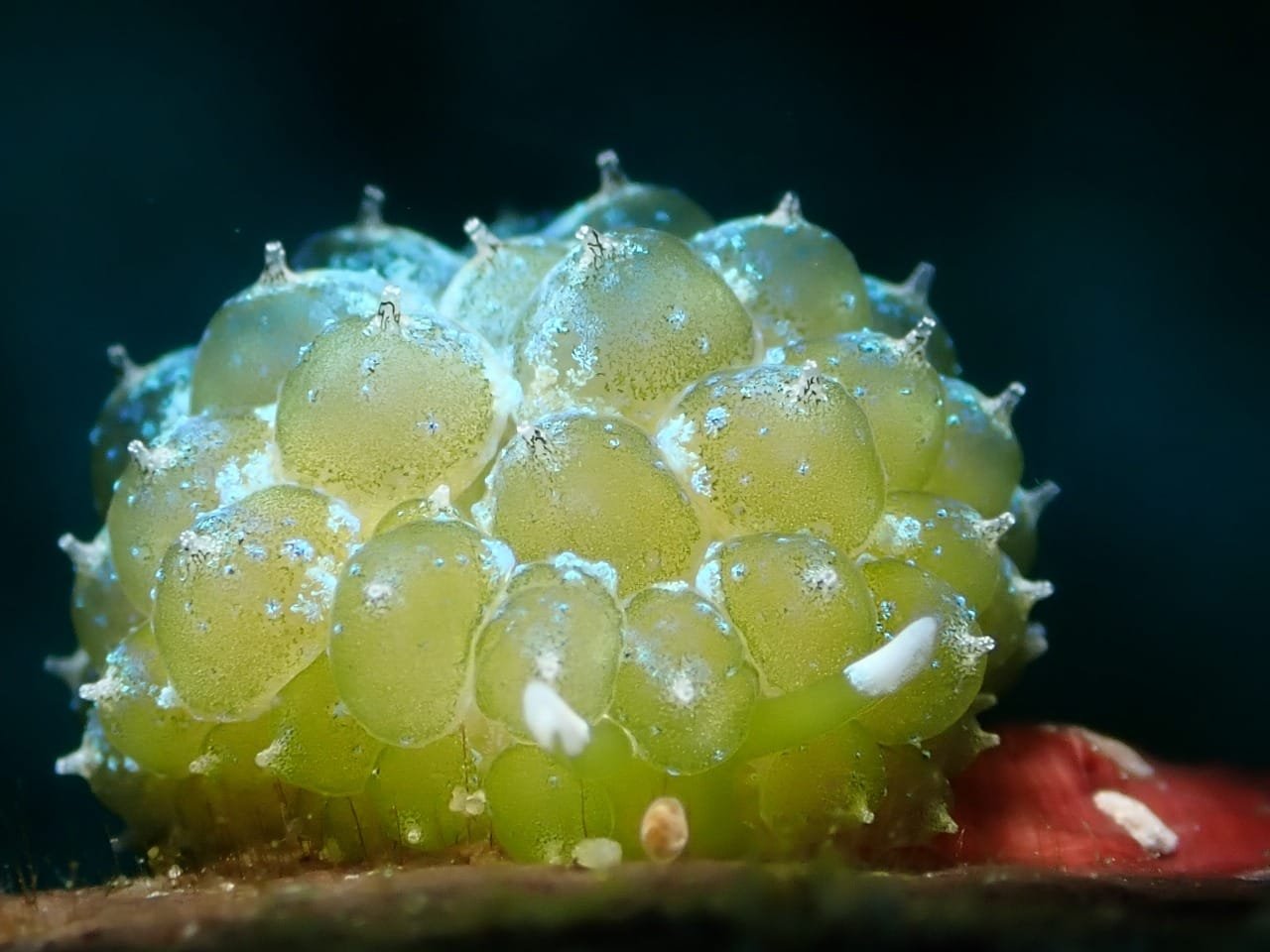
Sacoproteus smaragdinus achieves one of the most convincing examples of camouflage in the ocean. Its bright emerald green body and swollen, bubble-like cerata match the individual bladders of Caulerpa sea grape algae so precisely that divers routinely swim past the animal without noticing it. Furthermore, the colour is not superficial — it comes directly from the chloroplasts the slug retains from its food source.
Adults grow up to 50 mm in length, making this one of the larger sacoglossans. However, body colour varies depending on the specific Caulerpa species the animal feeds on — ranging from bright emerald green to yellow-green. A single pair of enrolled rhinophores sits at the head and also mimics algal fronds. To identify this species reliably, look for the distinctive bubble-shaped cerata and their arrangement on the body.
Taxonomy note: Originally, scientists described this species as Stiliger smaragdinus (Baba, 1949). In 2018, however, Krug, Wong, Medina, Gosliner, and Valdés established the new genus Sacoproteus after molecular phylogenetic analysis confirmed it needed separate classification. Today, the accepted name is Sacoproteus smaragdinus (WoRMS AphiaID 1298640).
Behaviour and Biology
Sacoproteus smaragdinus feeds exclusively on Caulerpa racemosa and Caulerpa lentilifera — the same sea grape algae it so perfectly resembles. It pierces individual algal bladders with its specialised radula and extracts the cell contents. Moreover, it retains the algal chloroplasts through kleptoplasty, giving the body its vivid green colour and allowing it to supplement energy through photosynthesis.
The mimicry extends well beyond colour alone. When threatened, the animal positions itself among algal bladders and stays completely motionless. As a result, the combination of colour, body shape, and behaviour makes it one of the most effective examples of Batesian mimicry in opisthobranch sea slugs. Additionally, different Sacoproteus species have each evolved specialised radular teeth for specific Caulerpa species.
Distribution and Diving in Romblon
Throughout the Indo-Pacific, Sacoproteus smaragdinus appears wherever suitable Caulerpa habitat exists. Records come from Japan, Australia, New Caledonia, and the Philippines. In particular, the species occupies shallow water from 1 to 15 metres, favouring sandy substrate, reef edges, and rubble patches colonised by Caulerpa.
At Sunset Cove Romblon, this species offers a rare and exciting find for underwater photographers and videographers. Romblon counts among the documented Philippine locations for this species. Nevertheless, because its camouflage is extraordinarily effective, finding it requires patience and a methodical search approach. Scan carefully over Caulerpa racemosa patches at 1–10 m and look for slightly irregular bubble shapes or subtle movement. A top-down composition best captures the algal mimicry. For taxonomy see WoRMS AphiaID 1298640 and iNaturalist taxon 787079. Browse more species in our Marine Life Encyclopedia.
| Order | Sacoglossans (Sacoglossa) |
|---|---|
| Family | Limapontiidae |
| Genus | Sacoproteus |
| WoRMS AphiaID | 1298640 |
| iNaturalist | 787079 |
| Size | 10–50 mm |
|---|---|
| Colour Variations | Bright green body with bubble-like cerrata matching Caulerpa bladders; colour varies with diet — green to yellow-green depending on Caulerpa species consumed |
| Identifying Features | Bubble-like cerrata perfectly mimic Caulerpa sea grape bladders; single pair of enrolled rhinophores; extremely cryptic on host algae; bright emerald green body |
| Depth Range | 1–15 m (most common: 5 m) |
|---|---|
| Temperature | 24–30°C |
| Primary Prey / Host | Caulerpa racemosa, Caulerpa lentilifera (sea grape algae) |
| Seasonal Presence | Year-round |
|---|---|
| Egg Ribbon | White coiled ribbon deposited on host algae |
| Spawning Season | Unknown |
| Chemical Defence | Absent |
| Aposematic Colouring | Absent |
| Camouflage Strategy | Near-perfect Batesian mimicry of Caulerpa sea grape algae — body shape, colour and texture match host bladders; among the most convincing examples of algal mimicry in opisthobranchia |
| Escape Response | Relies entirely on crypsis; extremely difficult to spot on host algae; will remain motionless when disturbed |