
coming
soon
coming
soon
coming
soon
Identification and Appearance
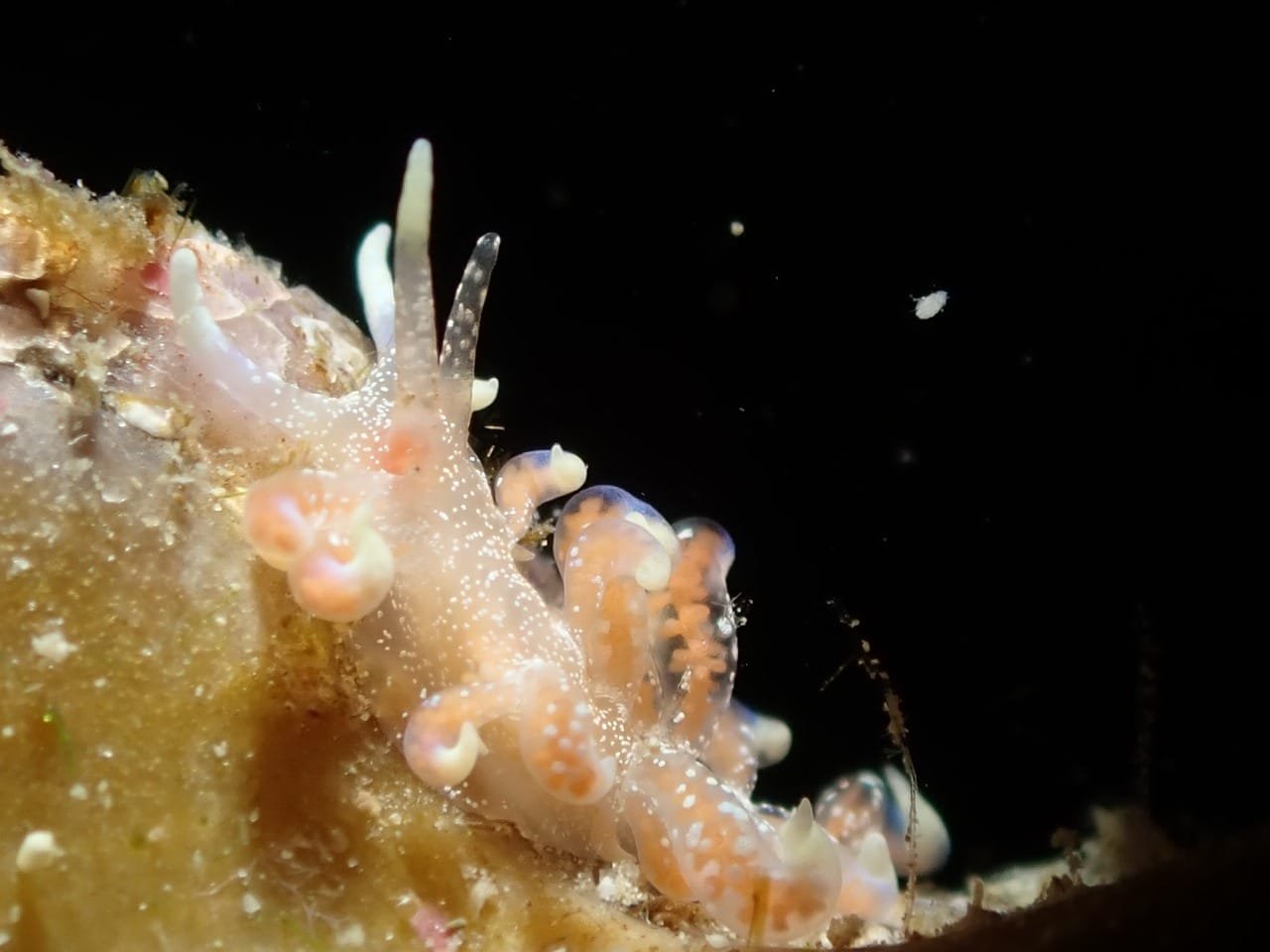
Phyllodesmium poindimiei is a slender, elongate aeolid nudibranch. Its body is translucent to pale white. The cerata are cylindrical and smooth, with tips that curve gently inward. Rows of these cerata run along both sides of the dorsum.
One of the most striking features is the blue iridescence on the cerata and rhinophores. Additionally, the pink to orange digestive gland branches are visible through the transparent cerata walls. Together, these colours give the animal a delicate, glowing appearance underwater. The rhinophores are long and smooth. Furthermore, they are equal in length to the cephalic tentacles — a useful field identification detail.
Adults typically reach 15–50mm in length. In contrast to many other Phyllodesmium species, P. poindimiei does not harbour zooxanthellae in its tissues. It therefore relies entirely on its prey for nutrition rather than supplementing its diet with photosynthesis.
Behaviour and Biology
Phyllodesmium poindimiei is a highly specialised predator. It feeds almost exclusively on azooxanthellate octocorals in the genus Carijoa (Snowflake coral) and related Telesto spp. As a result, spotting the nudibranch requires first locating its host coral. The animal lives, feeds, and spawns directly on Carijoa colonies.
This species has attracted scientific interest for an unusual reason. Carijoa riisei, its primary prey, is an invasive octocoral that has spread rapidly through Hawaii. Researchers have studied P. poindimiei as a potential biocontrol agent. Laboratory and field studies confirm its specialised feeding behaviour and document its approximately annual life cycle. Notably, it spawns continuously throughout the year with no lunar pattern.
Like all nudibranchs, this species is a simultaneous hermaphrodite. It mates reciprocally with any individual it encounters on a shared coral colony. Egg masses appear as small white coiled ribbons deposited directly on the host. After hatching, larvae are planktotrophic — they feed in the water column before settling back onto octocoral substrate.
Distribution and Diving in Romblon
Phyllodesmium poindimiei is distributed across the Indo-West Pacific. Records exist from New Caledonia, Australia, the Philippines, and Hawaii. It occurs in shallow benthic zones from 0 to 25 metres. Typically, it is found on hard substrate, reef walls, and overhangs where Carijoa octocoral colonies grow.
At Sunset Cove Romblon, this species appears year-round wherever Snowflake coral is present. For underwater photographers and videographers, the blue iridescence on the cerata makes it a beautiful macro subject. Look carefully on white Carijoa colonies at 5–20m on reef walls. A side-on shot best captures the cerata rows and their iridescent sheen.
For taxonomy and global records, see WoRMS AphiaID 534073 and iNaturalist taxon 54645. Browse more species in our Marine Life Encyclopedia.
| Order | Nudibranchs (Nudibranchia) |
|---|---|
| Suborder | Aeolidina (Aeolid Nudibranchs) |
| Family | Myrrhinidae |
| Subfamily | Phyllodesmiinae |
| Genus | Phyllodesmium |
| WoRMS AphiaID | 534073 |
| iNaturalist | 54645 |
| Size | 15–50 mm |
|---|---|
| Colour Variations | Translucent to white body; cylindrical smooth cerata with blue iridescence; pink/orange digestive gland visible through cerata walls; cerata tips curved |
| Identifying Features | Slender translucent body; long smooth rhinophores equal in length to cephalic tentacles; blue iridescent sheen on cerata and rhinophores; visible pink/orange digestive gland branches inside cerata |
| Depth Range | Up to 25 m (most common: 10 m) |
|---|---|
| Temperature | 24–30°C |
| Primary Prey / Host | Carijoa riisei (Snowflake coral); also Telesto spp. |
| Seasonal Presence | Year-round |
|---|---|
| Egg Ribbon | White coiled ribbon |
| Spawning Season | Year-round (continuous spawning) |
| Chemical Defence | Absent |
| Aposematic Colouring | Absent |
| Camouflage Strategy | Pale translucent body blends with white Carijoa octocoral colonies; blue iridescence may serve as aposematic warning |
| Escape Response | Relies on crypsis on host octocoral; crawls away when disturbed |