
coming
soon
coming
soon
The Xenia Mimic
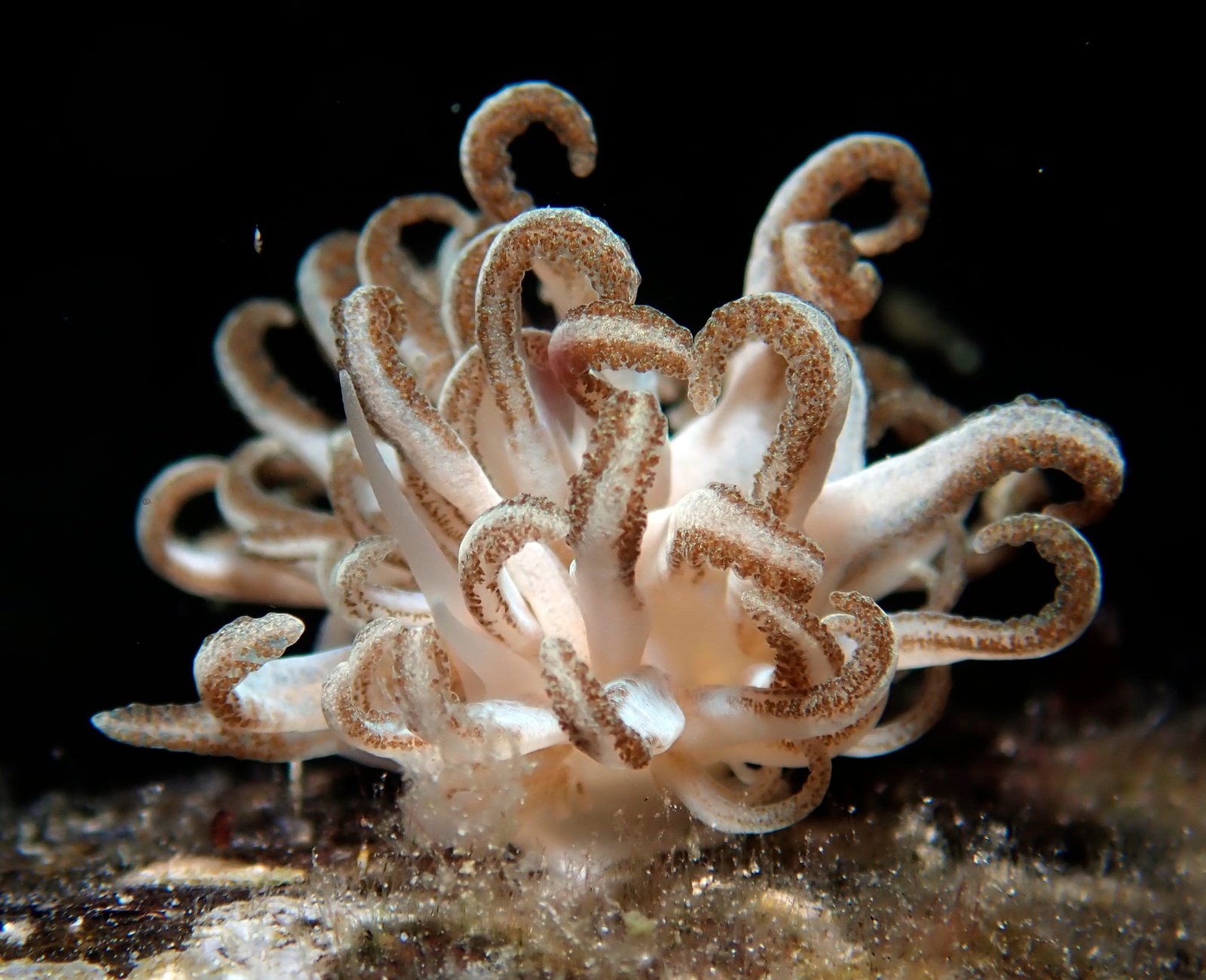
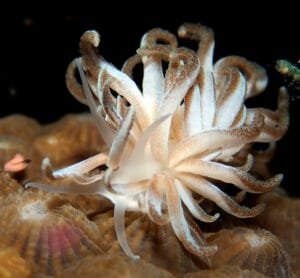
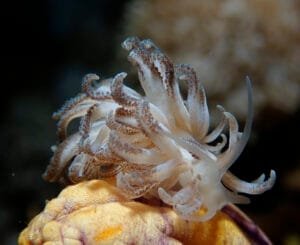
Phyllodesmium jakobsenae (Burghardt & Wägele, 2004) is one of the most convincingly camouflaged nudibranchs at our macro dive sites in Romblon, Philippines. It feeds exclusively on Xenia soft coral and mimics it almost perfectly. Its cerata match the shape and colour of Xenia polyps. As a result, it is nearly invisible on the colony. It belongs to the order Nudibranchia, suborder Aeolidina, family Myrrhinidae. Furthermore, it is solar powered — retaining Xenia‘s zooxanthellae in unique sac-like structures in its cerata. You can find it on iNaturalist.
Solar Power & Camouflage Combined
The zooxanthellae in this species are stored in sac-like terminal structures on the flattened, light-facing side of each ceras. This unique arrangement maximises sunlight absorption. Consequently, Phyllodesmium jakobsenae generates energy from photosynthesis while simultaneously being camouflaged as part of its coral home. Its close relatives Phyllodesmium longicirrum and Phyllodesmium colemani are also documented in our Marine Life Encyclopedia. In contrast to those species, however, this nudibranch targets Xenia rather than Sarcophyton or organ pipe coral.
Finding It at Sunset Cove
At Sunset Cove Beach & Dive Resort, our guides search Xenia soft coral colonies carefully at 5 to 15 metres depth. The animal sits completely still and blends with the pulsing polyps. Therefore, finding it requires patience and a very close look. For underwater macro photographers in Romblon, the camouflage story makes this species one of the most compelling subjects possible. Consequently, a well-composed shot showing the nudibranch against the matching coral background is one of the most striking images from our dive sites.
| Order | Nudibranchs (Nudibranchia) |
|---|---|
| Suborder | Aeolidina (Aeolid Nudibranchs) |
| Family | Myrrhinidae |
| Subfamily | Phyllodesmiinae |
| Genus | Phyllodesmium |
| WoRMS AphiaID | 388630 |
| iNaturalist | 54648 |
| Size | 10–30 mm |
|---|---|
| Colour Variations | Body colour and ceratal shape closely mimic Xenia soft coral — translucent white to pale grey with ceratal branches matching the pulsing polyps of Xenia colonies. Zooxanthellae stored in unique sac-like terminal structures concentrated on the flattened, light-facing side of each ceras — maximising solar energy capture. The mimicry of Xenia is among the most convincing camouflage strategies documented in any nudibranch species. |
| Identifying Features | Cerata shaped and coloured to mimic Xenia soft coral polyps — the most distinctive identifying feature. Sac-like zooxanthellae structures visible as brownish terminal clusters on cerata under magnification. Always found directly on Xenia colonies. Distinguished from Phyllodesmium colemani (which mimics Tubipora) and P. longicirrum (which mimics Sarcophyton) by the Xenia association and ceratal shape. Body translucent pale grey to white. |
| Substrate | coral |
|---|---|
| Depth Range | 1–20 m (most common: 8 m) |
| Temperature | 24–29°C |
| Primary Prey / Host | Xenia spp. (soft coral, family Xeniidae) |
| Active Time | day, night |
|---|---|
| Seasonal Presence | Year-round — dependent on presence of Xenia soft coral colonies |
| Egg Ribbon | White, coiled ribbon |
| Spawning Season | Not yet documented at SSC |
| Chemical Defence | Present |
| Aposematic Colouring | Absent |
| Camouflage Strategy | Exceptional Xenia soft coral mimicry — ceratal shape, branching pattern and colouration match Xenia polyps almost exactly. One of the most convincing examples of camouflage in the nudibranch world. |
| Escape Response | Primary defence is camouflage. Remains motionless on Xenia colonies. No ceratal autotomy. Chemical deterrents from Xenia prey provide secondary defence. |
-
A new solar powered species of the genus Phyllodesmium Ehrenberg, 1831 (Mollusca: Nudibranchia: Aeolidoidea) from Indonesia with analysis of its photosynthetic activity and notes on biology
Burghardt, I. & Wägele, H. (2004). Zootaxa 596: 1–18