
coming
soon
coming
soon
coming
soon
coming
soon
A Newly Described Species
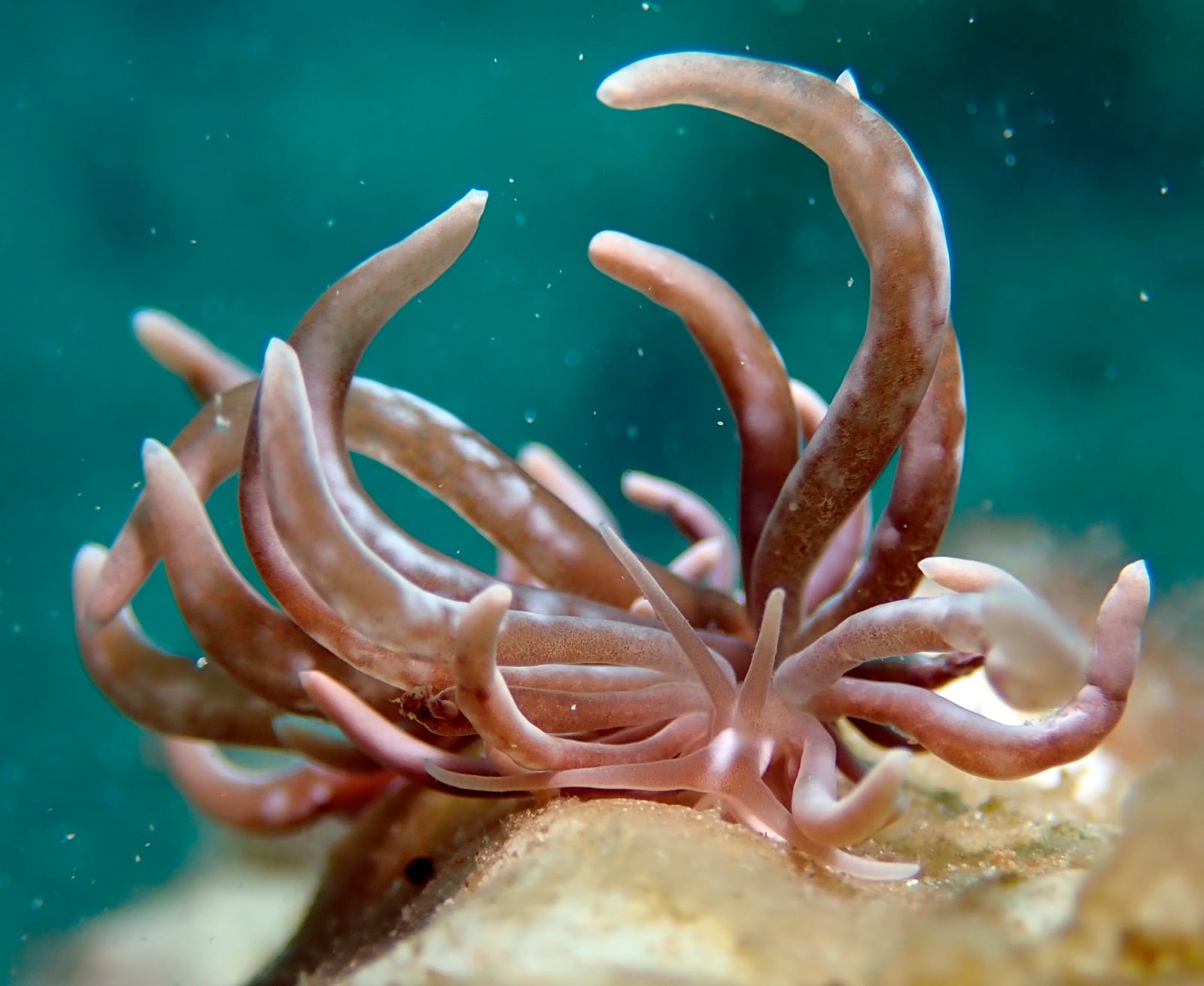
Cyerce katiae (Moreno, Gosliner, Wilson, Krug & Valdés, 2025) is one of the rarest butterfly sea slugs at our macro dive sites in Romblon, Philippines. Divers previously called it Cyerce sp. 4 or Cyerce sp. 4 (NSSI2). Scientists formally described it in 2025 as part of a major revision of the genus Cyerce. It belongs to the order Sacoglossa, family Caliphyllidae. Its close relatives Cyerce nigra and Cyerce blackburnae are also documented in our Marine Life Encyclopedia.
How It Defends Itself
Like all Cyerce species, Cyerce katiae has large, flattened, leaf-like cerata. These cerata carry a distinctive honeycomb pattern — hence its former dive community name. When a predator attacks, the animal sheds its cerata. The cerata continue to writhe after separation. As a result, the predator focuses on the moving cerata while the animal escapes. This defence strategy is called ceratal autotomy. Furthermore, the species stores chemical compounds in its body as an additional deterrent.
Finding It at Sunset Cove
At Sunset Cove Beach & Dive Resort, Cyerce katiae holds Epic rarity status. This means only one to three confirmed sightings exist at our dive sites. Our guides search sandy rubble substrate near Udotea algae patches at depth. The animal is small — just 5 to 15 mm. Therefore, it requires maximum magnification and a very slow approach. For underwater macro photographers in Romblon, spotting this species is one of the most exciting possible encounters on any dive.
| Order | Nudibranchs (Nudibranchia) |
|---|---|
| Suborder | Aeolidina (Aeolid Nudibranchs) |
| Family | Myrrhinidae |
| Subfamily | Phyllodesmiinae |
| Genus | Phyllodesmium |
| WoRMS AphiaID | 548883 |
| iNaturalist | 418427 |
| Size | 10–18 mm |
|---|---|
| Colour Variations | Body colour closely matches its prey Tubipora musica — pinkish-red to orange-red cerata with white tips, blending perfectly with the red skeletal tubes of the organ pipe coral. Zooxanthellae stored in aggregations of terminal chambers distributed across the ceratal wall, visible as darker spotting. Body translucent to pale. An extremely well-camouflaged species — almost impossible to spot without knowing exactly what to look for. |
| Identifying Features | Small — only 10–18 mm. Cerata coloured to match Tubipora musica organ pipe coral. Always found directly on or immediately beside Tubipora colonies. Zooxanthellae visible as clustered chambers in cerata walls. Distinguished from P. longicirrum by much smaller size and specific association with organ pipe coral rather than Sarcophyton. Distinguished from other Phyllodesmium by habitat association and ceratal colouration matching red coral. |
| Substrate | coral |
|---|---|
| Depth Range | 2–10 m (most common: 5 m) |
| Temperature | 24–29°C |
| Primary Prey / Host | Tubipora musica (Organ Pipe Coral, family Tubiporidae) |
| Active Time | day, night |
|---|---|
| Seasonal Presence | Year-round — dependent on presence of Tubipora musica colonies |
| Egg Ribbon | White, coiled ribbon |
| Spawning Season | Not yet documented at SSC |
| Chemical Defence | Present |
| Aposematic Colouring | Absent |
| Camouflage Strategy | Exceptional colour match with Tubipora musica organ pipe coral — the pinkish-red cerata are nearly indistinguishable from the red skeletal tubes of the coral colony. One of the most effectively camouflaged nudibranchs in Romblon waters. |
| Escape Response | Primary defence is camouflage. Remains motionless when threatened. No ceratal autotomy — unlike Cyerce species. |
-
Further studies on the taxonomy and biology of the octocoral-feeding genus Phyllodesmium Ehrenberg, 1831 (Nudibranchia: Aeolidoidea)
Rudman, W.B. (1991). Journal of Molluscan Studies 57: 167–203