
coming
soon
coming
soon
coming
soon
coming
soon
Identification and Appearance
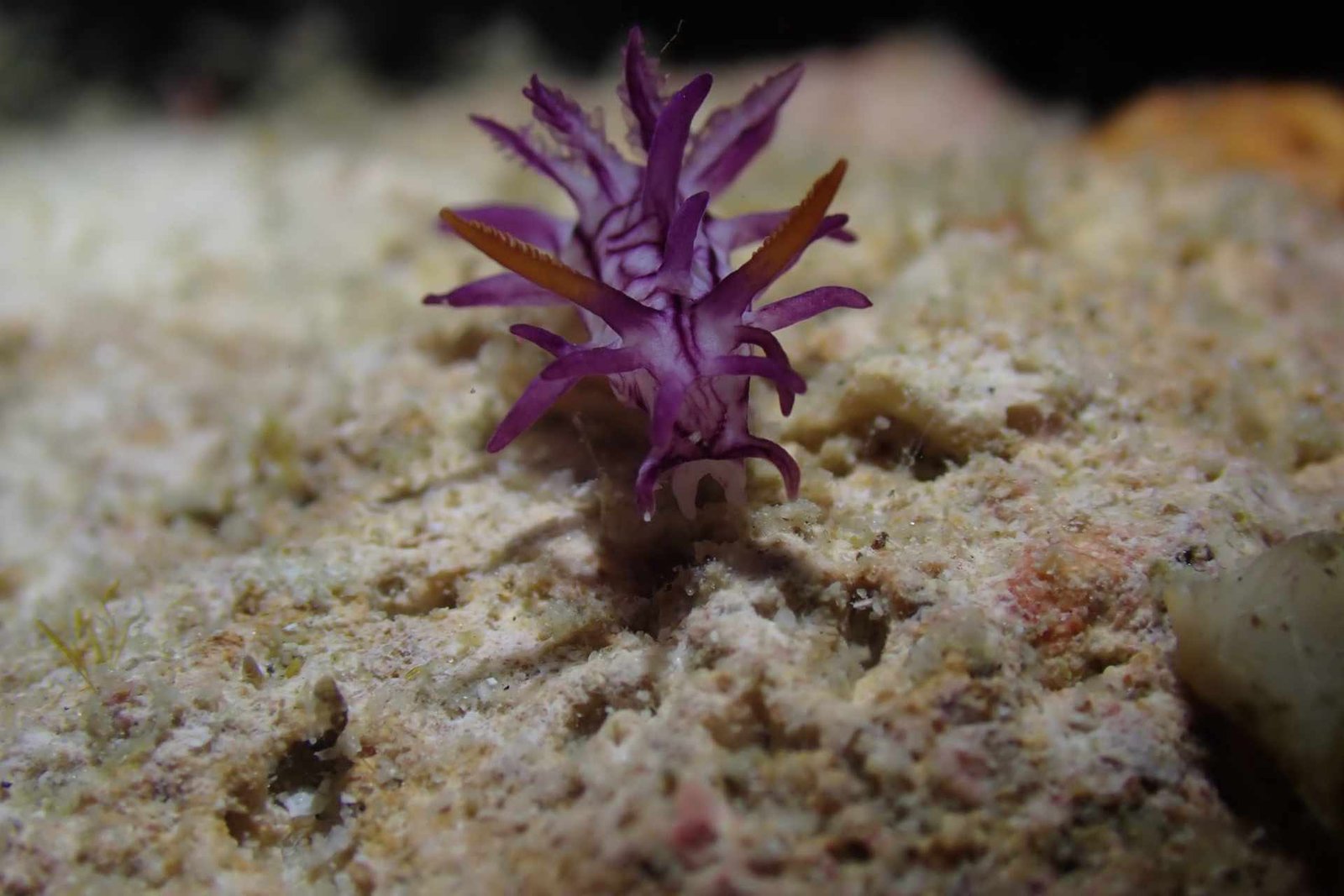
Okenia purpureolineata is a small, strikingly patterned dorid nudibranch. Its body is translucent white. Running along the dorsum are several distinct purple longitudinal lines. These lines give the species its name — purpureolineata means “purple-lined” in Latin.
The body is broad and dorso-ventrally flattened. Along each side of the mantle edge sit multiple elongate lateral papillae. Additionally, there are dorsal papillae scattered across the back. The rhinophores have lamellate folds and show purple banding. All papillae and rhinophores share the purple-and-white colour pattern of the main body.
Adults typically reach 8–20mm in length. In contrast to some other goniodorids, this species stays small and slender. The gills form a semicircle in the posterior midline around the anus. Furthermore, the radula follows the typical goniodorid pattern: one large inner lateral tooth and one small outer lateral tooth per row.
Taxonomy note: WoRMS and iNaturalist now list this species under the accepted name Bermudella purpureolineata (Gosliner, 2004) following molecular revisions of Goniodorididae. However, Okenia purpureolineata remains the name widely used by divers and in the field guide literature.
Behaviour and Biology
Okenia purpureolineata is a specialist predator of ctenostome bryozoans in the genus Amathia. It feeds, lives, and lays its eggs directly on these encrusting bryozoan colonies. As a result, spotting the animal almost always means first locating its host. The cryptic purple lines blend visually with the branching patterns of the bryozoan colony.
Like all nudibranchs, this species is a simultaneous hermaphrodite. It can mate reciprocally with any conspecific it encounters on a shared bryozoan colony. Egg masses are deposited as small white coiled ribbons directly on the host. After hatching, veliger larvae are planktonic before settling back onto bryozoan substrate.
Distribution and Diving in Romblon
Okenia purpureolineata is distributed across the tropical Indo-Pacific. It has been recorded from the Philippines, Japan, Indonesia, and Papua New Guinea. It lives in shallow to mid-depth reef zones from 3 to 25 metres. Typically, it occurs where encrusting Amathia bryozoan colonies grow on rubble fields, reef bases, and hard substrate.
At Sunset Cove Romblon, this species is a rare find in our macro zones. For underwater photographers and videographers, the purple lines make it a highly distinctive subject. However, its small size and bryozoan crypsis make it easy to miss. Look carefully at encrusting growth on rubble at 5–20m, especially at night. A close-up lens is essential for a sharp identification shot showing the purple lines clearly.
For taxonomy and records, see WoRMS AphiaID 1723429 and iNaturalist taxon 1521026. Browse more species in our Marine Life Encyclopedia.
| Order | Nudibranchs (Nudibranchia) |
|---|---|
| Suborder | Doridina (Dorid Nudibranchs) |
| Family | Goniodorididae |
| Subfamily | Goniodoridinae |
| Genus | Okenia |
| WoRMS AphiaID | 1723429 |
| iNaturalist | 1521026 |
| Size | 8–20 mm |
|---|---|
| Colour Variations | Translucent white body with purple longitudinal lines along dorsum and papillae; rhinophores with purple banding |
| Identifying Features | Distinctive purple lines running lengthwise along white body; multiple elongate lateral and dorsal papillae; lamellate rhinophores |
| Depth Range | 3–25 m (most common: 10 m) |
|---|---|
| Temperature | 24–30°C |
| Primary Prey / Host | Amathia spp. (ctenostome bryozoans) |
| Seasonal Presence | Year-round |
|---|---|
| Egg Ribbon | White coiled ribbon |
| Spawning Season | Unknown |
| Chemical Defence | Absent |
| Aposematic Colouring | Absent |
| Camouflage Strategy | Cryptic coloration matches encrusting bryozoan colonies; purple lines mimic colony branching patterns |
| Escape Response | Relies on crypsis on host bryozoan; limited mobility |