
coming
soon
coming
soon
coming
soon
coming
soon
Identification and Appearance
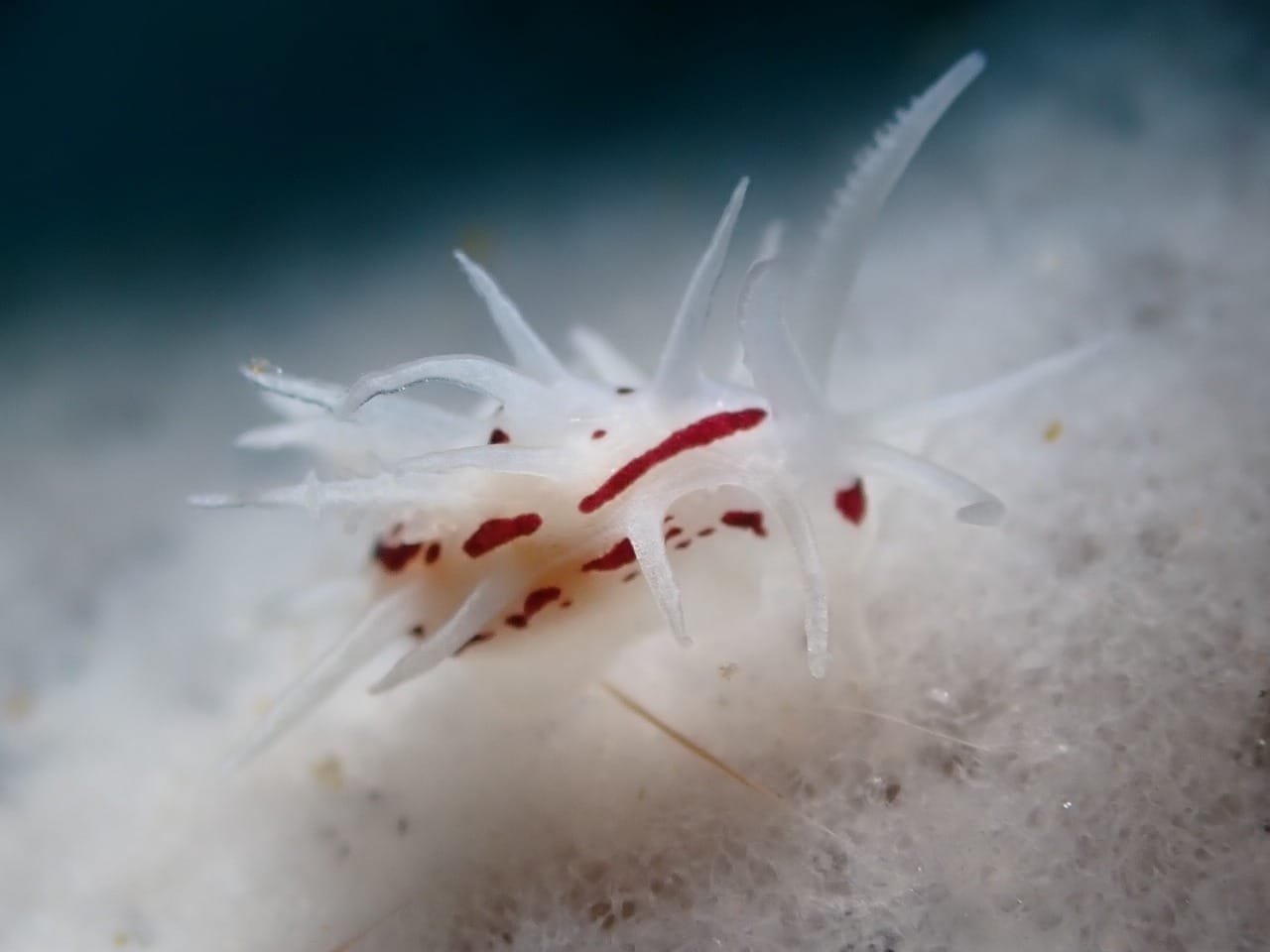
Okenia brunneomaculata is a small but distinctively marked dorid nudibranch. Its white to cream body carries scattered brown spots that give the species both its common and scientific names — brunneo meaning brown and maculata meaning spotted. Furthermore, the body surface bears rows of conical white-tipped tubercles that break up the outline against encrusting bryozoan substrate. The combination of white body, brown spots, and white-tipped bumps makes identification straightforward once you know what to look for.
Adults typically reach 10–25 mm in length. The rhinophores are lamellate with approximately 15 lamellae and carry brown tips. The oral tentacles are pointed and also brown-tipped. The branchial plume consists of 5–7 gills surrounding the anal papilla, white in colour with brown markings at the tips. Overall the body is firm and compact, with a smooth-edged mantle that sits close to the substrate.
Taxonomy note: Described by Gosliner & Behrens (1997) from specimens collected in the Philippines. It belongs to the family Goniodorididae. WoRMS AphiaID 597802 is the accepted name. The species has also been recorded from Indonesia, Japan, and Papua New Guinea, confirming a wide central Indo-Pacific distribution.
Behaviour and Biology
Okenia brunneomaculata feeds on bryozoans — small colonial invertebrates that form encrusting mats on rubble, rock, and reef surfaces. Because bryozoans are widely distributed across reef habitats, this species is not restricted to a single microhabitat. Nevertheless, it is most commonly found on rubble slopes and reef edges where bryozoan growth is most dense.
Like many dorids, this species is primarily nocturnal and therefore most active and visible during night dives. During the day it tends to tuck into crevices or remain motionless on its food source. Additionally, it possesses chemical defences typical of dorid nudibranchs — distasteful compounds sequestered from its bryozoan diet that deter most predators. The brown and white colouration may also serve an aposematic warning function, signalling its unpalatability to experienced predators.
Distribution and Diving in Romblon
Throughout the central Indo-Pacific, Okenia brunneomaculata appears on rubble, sand, and reef edges wherever bryozoan colonies grow. Records come from the Philippines, Indonesia, Japan, and Papua New Guinea. In Romblon specifically, it occupies depths from 5 to 30 metres and favours the rubble zones between coral heads and sandy channels that characterise many of our dive sites.
At Sunset Cove Romblon, the Brown-Spotted Okenia is a rewarding find for underwater photographers and videographers, particularly on night dives when it is most active. Search rubble and reef edges at 5–25m, paying close attention to encrusting bryozoan colonies. The distinctive brown-spotted white body stands out well under torch light at night. During the day, check crevices and the underside of rubble. A macro lens or diopter is essential given the small size. For taxonomy see WoRMS AphiaID 597802 and iNaturalist taxon 416044. Browse more species in our Marine Life Encyclopedia.
| Order | Nudibranchs (Nudibranchia) |
|---|---|
| Suborder | Doridina (Dorid Nudibranchs) |
| Family | Goniodorididae |
| Subfamily | Goniodoridinae |
| Genus | Okenia |
| WoRMS AphiaID | 597802 |
| iNaturalist | 416044 |
| Size | 10–25 mm |
|---|---|
| Colour Variations | White to cream body with distinctive brown spots; white-tipped conical tubercles throughout body; rhinophores and oral tentacles with brown tips; gills white with brown markings at tips |
| Identifying Features | White/cream body with scattered brown spots; white-tipped tubercles in rows along body; brown-tipped rhinophores and oral tentacles; branchial plume white with brown markings; found on or near bryozoan colonies |
| Depth Range | 5–30 m (most common: 15 m) |
|---|---|
| Temperature | 24–30°C |
| Primary Prey / Host | Bryozoans |
| Seasonal Presence | Year-round |
|---|---|
| Egg Ribbon | White coiled ribbon deposited near host bryozoan |
| Spawning Season | Unknown |
| Chemical Defence | Present |
| Aposematic Colouring | Present |
| Camouflage Strategy | White tubercles and brown spots break up body outline on encrusting bryozoan substrate |
| Escape Response | Autotomy — can shed body parts; slow crawl away from threat |