
coming
soon
coming
soon
coming
soon
coming
soon
A Master of Invisibility
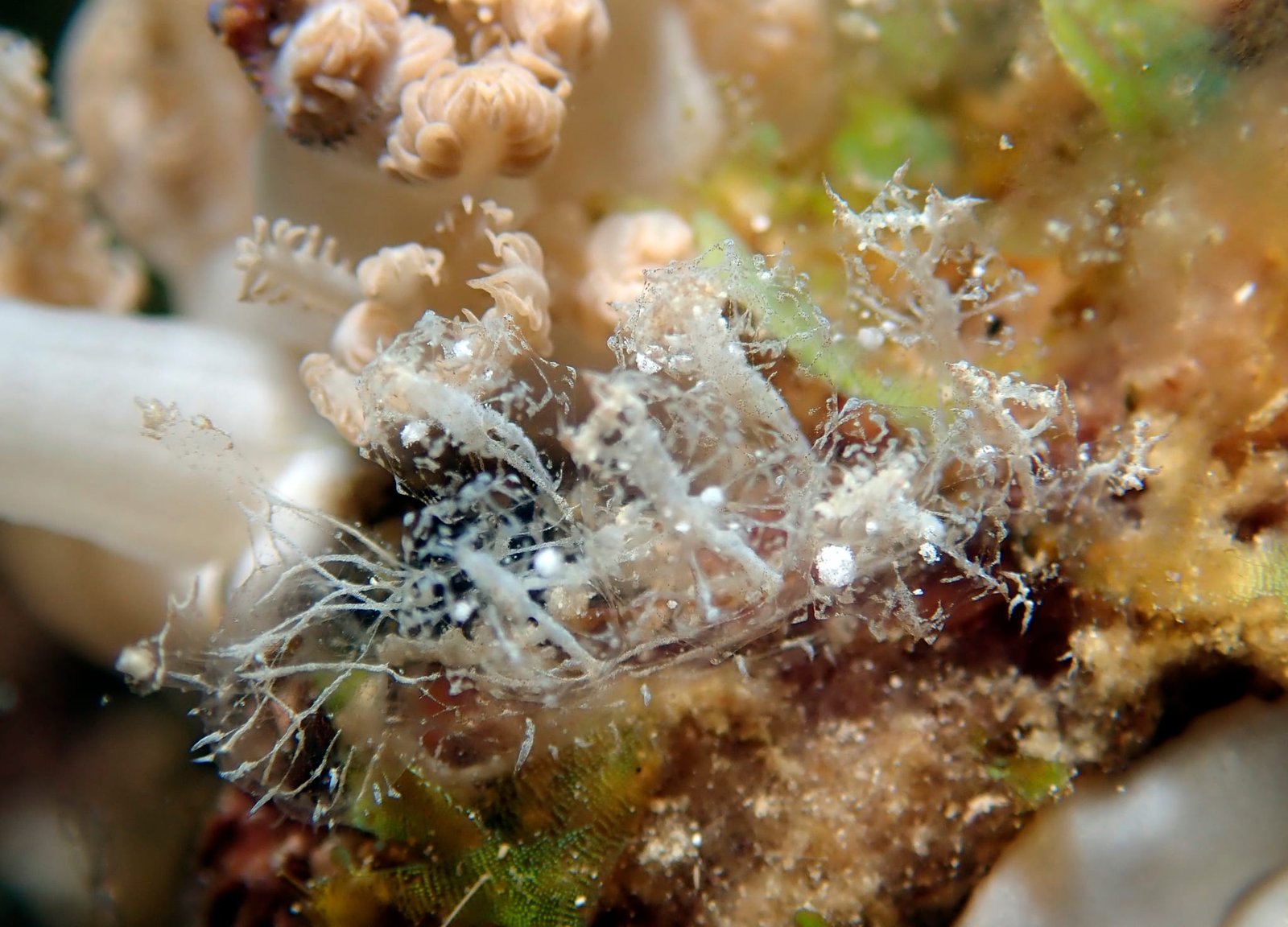
Melibe engeli (Risbec, 1937) is one of the most extraordinary nudibranchs at our macro dive sites in Romblon, Philippines. Its body is almost entirely transparent. This makes it one of the most cryptic nudibranchs in the Indo-Pacific. In addition, brown zooxanthellae — photosynthetic algae — are visible as tiny speckles through the transparent body wall. Remarkably, Melibe engeli captures these algae from the water column during feeding, rather than from its prey. As a result, it gains additional energy from sunlight. It belongs to the order Nudibranchia, suborder Dendronotina, family Tethydidae. You can find it on iNaturalist.
How It Hunts
Like all Melibe species, Melibe engeli is an active predator. It uses a large, expandable oral hood to catch small crustaceans and copepods. The hood opens wide, then contracts rapidly when prey is detected. Notably, this species has no radula at all — it swallows prey whole. It is closely related to Melibe colemani, also documented in our Marine Life Encyclopedia. Both species share the same family and the same hunting strategy. Originally described from New Caledonia, Gosliner and Smith first documented it in the Philippines in 2003 — confirming Romblon as part of its range.
Finding It at Sunset Cove
At Sunset Cove Beach & Dive Resort, Melibe engeli is one of the rarest finds possible. Its transparency makes it almost invisible against sandy rubble. Therefore, finding it requires a slow search and a trained eye. Night dives offer the best chance — the oral hood is often extended during active feeding. For underwater macro photographers in Romblon, a shot of this species against a dark background reveals its ghostly transparent body. Consequently, it is one of the most prized images from our dive sites.
| Order | Nudibranchs (Nudibranchia) |
|---|---|
| Suborder | Dendronotina |
| Family | Tethydida |
| Subfamily | Melibinae |
| Genus | Melibe |
| WoRMS AphiaID | 593362 |
| iNaturalist | 467983 |
| Size | 30–60 mm |
|---|---|
| Colour Variations | Body almost entirely transparent — one of the most translucent nudibranchs in the Indo-Pacific. Brown zooxanthellae (Symbiodinium sp.) scattered throughout the body and visible through the transparent integument, giving a faint brownish tinge. Cylindrical cerata bear visible internal digestive gland ramifications. No significant colour variation documented — the transparency itself is the defining feature. Juveniles are even more transparent than adults. |
| Identifying Features | Transparent to near-invisible body with cylindrical cerata. Distinguishable from the closely related Melibe colemani by its smaller oral hood and cylindrical (not flattened) cerata. Zooxanthellae visible as brown speckles throughout body under magnification. Oral hood net-like with sensory papillae of equal length — a key distinguishing feature from other Melibe species. Closely related to M. digitata and M. tuberculata but M. engeli's papillae are equal in length rather than graduated. |
| Substrate | sand, rubble |
|---|---|
| Depth Range | 3–25 m (most common: 10 m) |
| Temperature | 24–29°C |
| Primary Prey / Host | Small crustaceans, amphipods and copepods — caught using expandable oral hood |
| Active Time | day, night |
|---|---|
| Seasonal Presence | Year-round — easily overlooked due to near-total transparency |
| Egg Ribbon | White, coiled ribbon |
| Spawning Season | Not yet documented at SSC |
| Chemical Defence | Absent |
| Aposematic Colouring | Absent |
| Camouflage Strategy | Near-total transparency — one of the most cryptic nudibranchs in the Indo-Pacific. Almost invisible in the water column and against substrate, making it extremely difficult to spot without a trained eye. |
| Escape Response | Relies primarily on transparency for protection. Can contract body rapidly when disturbed. No ceratal autotomy — unlike Cyerce and Phyllodesmium. |
-
Systematic review and phylogenetic analysis of the nudibranch genus Melibe (Opisthobranchia: Dendronotacea) with descriptions of three new species
Gosliner, T.M. & Smith, V.G. (2003). Proceedings of the California Academy of Sciences 54(18): 302–355