
coming
soon
coming
soon
coming
soon
The Algae Mimic
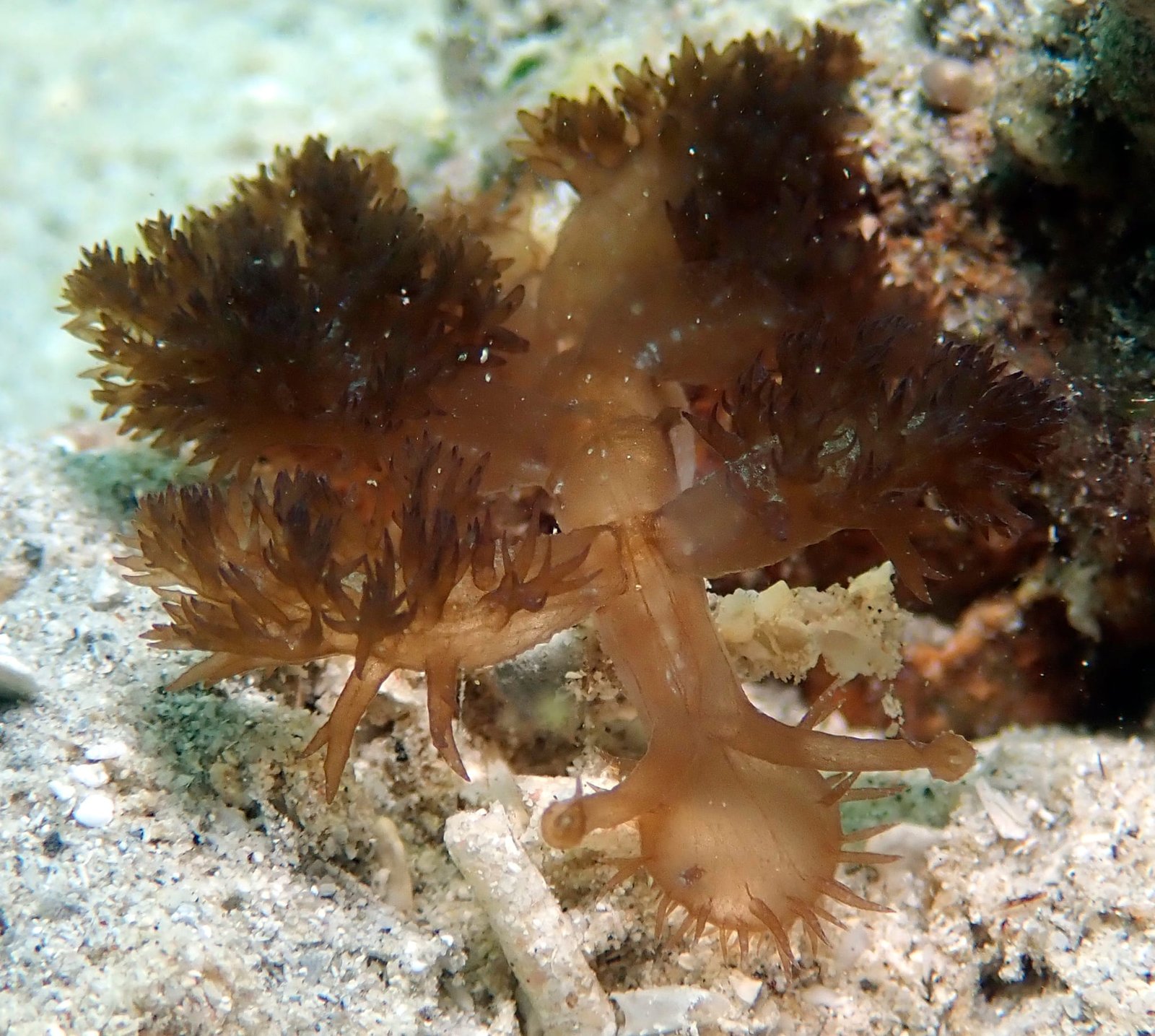
Melibe digitata (Gosliner & Smith, 2003) is one of the most unique nudibranchs at our macro dive sites in Romblon, Philippines. Its finely branched, finger-like cerata papillae closely resemble green algae. As a result, this species blends almost perfectly with its surroundings. It belongs to the order Nudibranchia, suborder Dendronotina, family Tethydidae. Furthermore, it is known almost exclusively from the Philippines — making Romblon one of the best places in the world to find it. You can find observations on iNaturalist.
Where to Find It
Melibe digitata hides under small dead rocks and rubble in very shallow water — typically 1 to 5 metres depth. It is closely related to Melibe colemani and Melibe engeli, also documented in our Marine Life Encyclopedia. Like all Melibe species, it uses an expandable oral hood to catch small crustaceans. Notably, it lacks a radula entirely — swallowing prey whole. It is small — just 10 to 30 mm — and its translucent brown body makes it difficult to spot against rubble. However, groups of a dozen or more individuals have been documented together with multiple egg masses.
Photographing It at Sunset Cove
At Sunset Cove Beach & Dive Resort, our guides search under small dead rocks in shallow areas. Turn rocks gently and always replace them carefully. The finely branched cerata are extraordinary under magnification. Therefore, diopters give the best results. For underwater macro photographers in Romblon, finding a group of Melibe digitata with egg masses is one of the most exciting shallow water encounters possible. Consequently, this species consistently produces some of the most unique macro images from our dive sites.
| Order | Nudibranchs (Nudibranchia) |
|---|---|
| Suborder | Dendronotina |
| Family | Tethydida |
| Subfamily | Melibinae |
| Genus | Melibe |
| WoRMS AphiaID | 388315 |
| iNaturalist | 779446 |
| Size | 10–30 mm |
|---|---|
| Colour Variations | Body translucent brown to greenish-brown. The branching regions of the cerata are darker brown. The branched digestive gland is clearly visible through the transparent body wall. Finely branched papillae on the cerata closely resemble green algae — providing effective camouflage. No significant colour variation documented between individuals. |
| Identifying Features | Distinguished by its finely branched, finger-like cerata papillae — unique among Melibe species found in Romblon waters. The papillae closely resemble algae. Body translucent brown-green. Always found under rocks or rubble in very shallow water. Much smaller than Melibe colemani and Melibe engeli. Closely related to M. tuberculata but distinguished by ceratal branching pattern and body colour. Known almost exclusively from the Philippines. |
| Substrate | sand, rubble |
|---|---|
| Depth Range | 1–15 m (most common: 5 m) |
| Temperature | 24–29°C |
| Primary Prey / Host | Small crustaceans, amphipods and copepods — caught using expandable oral hood |
| Active Time | day, night |
|---|---|
| Seasonal Presence | Year-round — found under rocks and rubble in very shallow water |
| Egg Ribbon | White, coiled ribbon — multiple egg masses often found together |
| Spawning Season | Groups with egg masses documented — multiple egg masses found together |
| Chemical Defence | Absent |
| Aposematic Colouring | Absent |
| Camouflage Strategy | Finely branched ceratal papillae closely resemble green algae — providing excellent camouflage on rubble and algae-covered substrate. Body translucency also aids concealment. |
| Escape Response | Hides under rocks and rubble. Relies on camouflage and cryptic hiding behaviour rather than active escape. |
-
Systematic review and phylogenetic analysis of the nudibranch genus Melibe (Opisthobranchia: Dendronotacea) with descriptions of three new species
Gosliner, T.M. & Smith, V.G. (2003). Proceedings of the California Academy of Sciences 54(18): 302–355