The Ghost Nudibranch
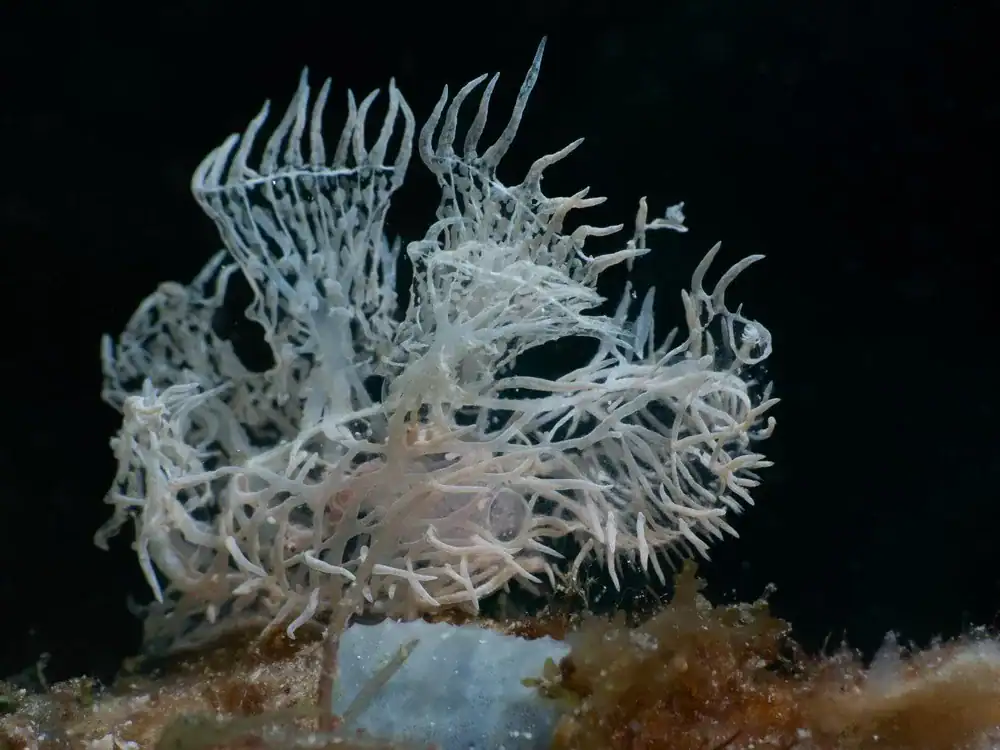
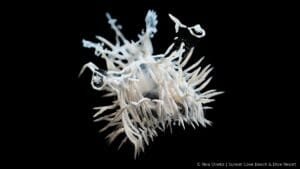
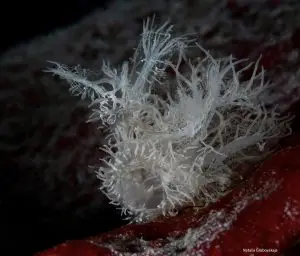
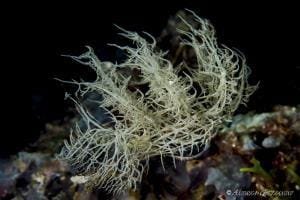
Melibe colemani (Gosliner & Smith, 2003) is one of the most impressive nudibranchs at our macro dive sites in Romblon, Philippines. Divers call it the Ghost Nudibranch. Its large, transparent body and enormous expandable oral hood make it unmistakeable. It belongs to the order Nudibranchia, suborder Dendronotina, family Tethydidae. Furthermore, it is closely related to Melibe engeli and Melibe digitata, also documented in our Marine Life Encyclopedia. Find it on iNaturalist.
The Oral Hood Hunter
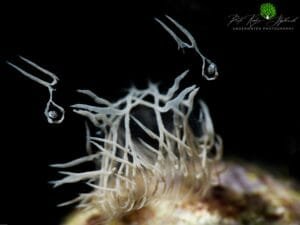
The oral hood of Melibe colemani is its defining feature. The hood opens wide and sweeps forward to trap small crustaceans and copepods from the water. It then contracts rapidly when prey enters. Notably, this species has no radula at all — it swallows prey whole. The cylindrical cerata run in rows along the dorsum. The digestive gland branches are clearly visible through the transparent body wall. In addition, some individuals harbour zooxanthellae — photosynthetic algae that provide supplementary energy. This makes it one of very few nudibranchs with both active predation and solar-powered nutrition.
Finding It at Sunset Cove
At Sunset Cove Beach & Dive Resort, our guides find this species on sandy and rubble substrate at 5 to 25 metres depth. The Ghost Nudibranch reaches up to 80 mm in length. Therefore, it is one of the larger nudibranch species at our dive sites. However, its transparency still makes it easy to miss. Night dives offer the best opportunity — the oral hood is often extended during active feeding. For underwater macro photographers in Romblon, a shot with the oral hood fully extended against a dark background is one of the most dramatic nudibranch images possible. Consequently, this species is one of the most sought-after subjects at Sunset Cove. Our experienced guides know exactly where to look and patiently position you for the perfect shot.
Taxonomy & Classification
| Order | Nudibranchs (Nudibranchia) |
|---|
| Suborder | Dendronotina |
|---|
| Family | Tethydida |
|---|
| Subfamily | Melibinae |
|---|
| Genus | Melibe |
|---|
| WoRMS AphiaID | 708806 |
|---|
| iNaturalist | 557665 |
|---|
| Dive Sites | Canyon 1, Paluksuhan, Santa Maria |
|---|
Formally described by Gosliner & Pola in 2012. Named after Neville Coleman (1938–2012) who first discovered the species in 2008 at Mabul Island, Malaysia — one month before the formal description was published. Phylogenetically placed within the same Melibe clade as M. engeli, M. digitata, and M. tuberculata. Synonym: none currently accepted.
Morphology
| Size | 25–60 mm |
|---|
| Colour Variations | Body almost entirely transparent/translucent with no colour morphs recorded. Internal digestive glands visible as a network of cream-white to whitish-brown tubules ramifying throughout the body and cerata — giving the iconic "string bag" or "pile of strings" appearance under direct light. |
|---|
| Identifying Features | Fully translucent gelatinous body with internal organs visible to the naked eye. Laterally flattened cerata with elongate apical papillae — key distinction from M. bucephala and M. engeli which have cylindrical cerata. Rhinophoral sheaths cylindrical with a single papilla at apex, vs. sail-shaped sheaths with numerous papillae in related species. Net-shaped oral hood used as feeding trap. Anterior and posterior ends appear almost identical at first glance. |
|---|
The oral hood is relatively small compared to other Melibe species, bearing a single row of thin papillae ventrally and larger papillae dorsally. Rhinophores well-separated, sited on the posterior of the hood, each comprising 3–4 lateral lamellae on a long thin cylindrical sheath. Body length typically 25–60mm. Often mistaken for decomposing tissue, debris, or a piece of hydroid colony.
Habitat & Ecology
| Substrate | coral, rubble, muck |
|---|
| Reef Zone | slope, flat |
|---|
| Depth Range | 5–25 m (most common: 10 m) |
|---|
| Temperature | 27–29°C |
|---|
| Current | none |
|---|
| Visibility | variable |
|---|
| Primary Prey / Host | Xenia coral (genus Xenia) — soft coral rubble. Also recorded feeding on small crustaceans, shelled caenogastropods, worms and benthic microfauna trapped via oral hood sweep. |
|---|
Activity & Behaviour
| Active Time | day, night |
|---|
| Tidal Correlation | none |
|---|
| Seasonal Presence | Year-round at Romblon — SSC field data to be added |
|---|
| Social Behaviour | solitary |
|---|
| Feeding Method | hunting |
|---|
| Feeding Time | opportunistic |
|---|
| Egg Ribbon | SSC field observation to be added |
|---|
| Spawning Season | SSC field observation to be added |
|---|
| Chemical Defence | Absent |
|---|
| Aposematic Colouring | Absent |
|---|
| Camouflage Strategy | Full body transparency allows blending with surroundings. Digestive tubule network mimics detritus, hydroids, sponges or algae on seafloor. Cryptobenthic — often indistinguishable from debris at first glance. |
|---|
| Escape Response | Undulating swimming motion when disturbed — lifts off substrate and drifts slowly. Slow floating movement in low current. Rarely moves quickly. |
|---|