
coming
soon
coming
soon
coming
soon
coming
soon
Pontoh's Pygmy Seahorse
Hippocampus pontohi Lourie & Kuiter, 2008
Epic ← Back to Encyclopedia Share: ✓ Copied!Identification and Appearance
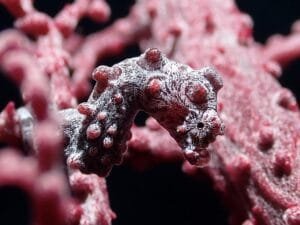
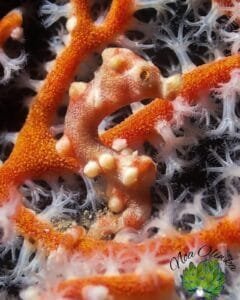
Hippocampus pontohi is one of the world’s smallest seahorses, reaching a maximum length of just 17mm. Despite its tiny size, it is immediately recognisable to macro divers and underwater photographers by several key features. The body carries a series of skin flaps called cirri that match the texture of hydroids and algae. Additionally, a distinctive red patch on the trunk stands out against the otherwise green, yellow, or brown body. The tail is pale with brown bands and wraps tightly around hydroid stems.
The head is relatively large, representing about 25% of total body length. The snout is moderately long and carries a small spine. Two prominent eyes sit high on the head. Like all seahorses, the body consists of bony rings rather than scales — 12 trunk rings in this species. Furthermore, a strongly raised cleithral ring and wing-like protrusions just behind the head help distinguish H. pontohi from similar pygmy seahorse species.
Taxonomy note: Hippocampus severnsi Lourie & Kuiter, 2008 is a junior synonym. The species was redescribed in 2018 by Short et al. following the description of Hippocampus japapigu from Japan, which shares several morphological features. The accepted name remains Hippocampus pontohi (WoRMS AphiaID 398433). Named after Hentje Pontoh, the Indonesian dive guide from Bunaken who first brought these pygmy seahorses to scientific attention.
Behaviour and Biology
Hippocampus pontohi feeds by ambush, using its prehensile snout to capture small crustaceans and copepods passing in the current. Rather than actively hunting, it grips its perch with its prehensile tail and waits for prey to drift within striking range. Consequently, it favours current-swept areas where food supply is reliable and continuous.
The species is commonly found in pairs and forms monogamous bonds typical of seahorses. Males carry the eggs in a ventral brood pouch, with examined specimens containing approximately 11 embryos per clutch. Moreover, the species is most active in the morning and late afternoon, particularly when not exposed to direct sunlight. In terms of defence, it relies entirely on its remarkable camouflage, pressing against its host and remaining motionless when threatened.
Distribution and Diving in Romblon
Throughout the central Indo-Pacific, Hippocampus pontohi appears wherever suitable hydroid habitat exists in current-swept conditions. Records come from Indonesia (Bunaken, Lembeh Strait, Wakatobi, Sorong, Cape Sri), the Philippines, and Fiji, typically at depths between 11 and 25 metres on vertical walls and in rock fissures facing away from the prevailing current.
At Sunset Cove Romblon, finding Pontoh’s Pygmy Seahorse is one of the most sought-after macro targets for underwater photographers and videographers. Search hydroids and algae on current-swept walls at 11–25m. Look specifically for a prehensile tail wrapped around a hydroid stem — the red trunk patch is the most reliable giveaway once you’re close enough. Shoot perpendicular to the body to capture the full profile and distinctive cirri. Steady buoyancy is essential, as current makes precise framing at this scale very challenging. For taxonomy see WoRMS AphiaID 398433 and iNaturalist taxon 102830. Browse more species in our Marine Life Encyclopedia.
| Order | Seahorses & Pipefishes (Syngnathiformes) |
|---|---|
| Family | Syngnathidae |
| Genus | Hippocampus |
| WoRMS AphiaID | 398433 |
| iNaturalist | 102830 |
| Size | 10–17 mm |
|---|---|
| Colour Variations | Green, yellow, or brown base with red markings and white skin flaps; colour varies with habitat; red patch on trunk diagnostic; pale tail with brown bands |
| Identifying Features | Extremely small size (10–17mm); skin flaps (cirri) on body; red patch on trunk; prehensile tail; no fin on dorsal ridge; found on hydroids and algae in current-swept areas |
| Substrate | Hydroids, algae, ascidians on rocky reef and current-swept walls |
|---|---|
| Reef Zone | Vertical walls, rock fissures, current-swept areas |
| Depth Range | 11–25 m (most common: 15 m) |
| Temperature | 24–30°C |
| Primary Prey / Host | Small crustaceans, copepods (ambush predator via prehensile snout) |
| Active Time | Diurnal — most active morning and late afternoon |
|---|---|
| Seasonal Presence | Year-round |
| Egg Ribbon | N/A — male broods eggs internally in ventral pouch |
| Spawning Season | Unknown — likely year-round in tropical waters |
| Chemical Defence | Absent |
| Aposematic Colouring | Absent |
| Camouflage Strategy | Body coloration and skin flaps (cirri) match host hydroids and algae; extremely cryptic; easily overlooked even by experienced divers |
| Escape Response | Relies entirely on crypsis; grips substrate with prehensile tail; rarely moves unless disturbed |