
coming
soon
coming
soon
coming
soon
coming
soon
Identification and Appearance
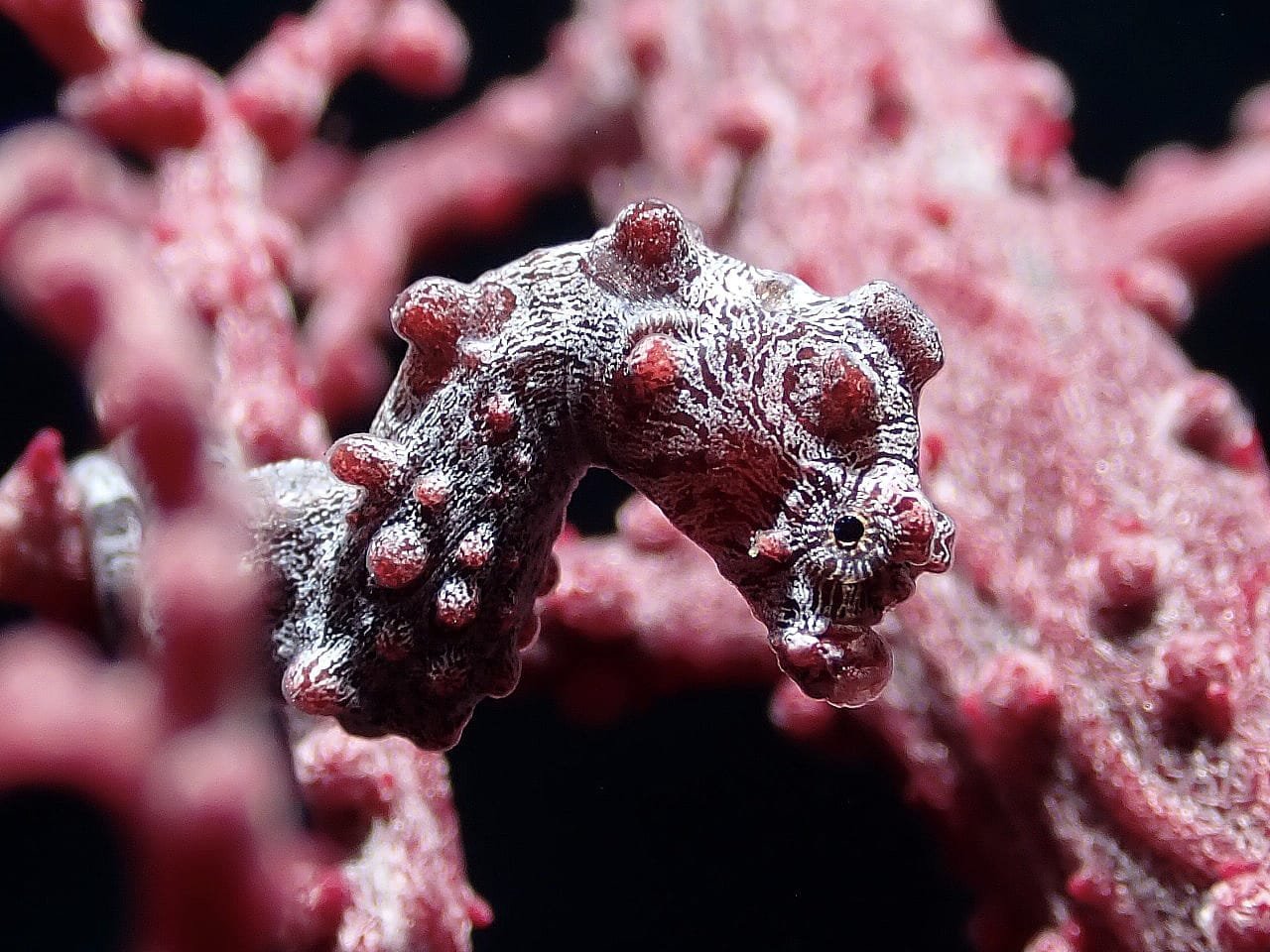
Hippocampus bargibanti is the original pygmy seahorse — the species that first introduced this extraordinary group of animals to science. Adults reach 14–27 mm in length and spend their entire lives on Muricella gorgonian sea fans. The body is covered in large, rounded tubercles that precisely replicate the polyps of the host coral. As a result, the animal is effectively invisible even at close range, and divers routinely swim past without noticing it.
The Grey-Purple Morph
The grey or purple colour morph lives exclusively on Muricella plectana, a gorgonian that grows in grey, purple, and lavender tones. The tubercles on these individuals are pink-red, precisely matching the extended polyps of the coral. This morph is typically the harder of the two to find — the muted tones blend so well into the fan that even a close inspection can leave a diver uncertain whether they are looking at the animal or the coral itself. For underwater photographers, the grey morph rewards extreme patience and a methodical scan of the entire fan surface.
The Yellow-Orange Morph
The yellow colour morph lives on Muricella paraplectana, a gorgonian that grows in bright yellow and orange tones. These individuals have orange tubercles and a warm yellow body that matches their host almost perfectly. Although slightly easier to spot than the grey morph due to the brighter colours, the camouflage is still exceptional. Many divers find their first pygmy seahorse by noticing the snout profile protruding slightly from the fan rather than recognising the body shape directly.
Importantly, colour is not a choice — it is determined permanently by whichever host coral the juvenile settles on. The animal cannot switch hosts or change colour. Furthermore, compared to other pygmy seahorse species such as H. denise and H. pontohi, H. bargibanti is more robust, with a deeper coronet and larger, more pronounced tubercles throughout the body.
Taxonomy note: First described by Whitley (1970) from New Caledonia. Named after Georges Bargibant, the naturalist who collected the type specimen while dredging gorgonians — noticing the tiny seahorse only after the coral was brought to the laboratory. This accidental discovery in 1969 introduced the world to pygmy seahorses. The accepted WoRMS AphiaID is 212613.
Behaviour and Biology
Hippocampus bargibanti feeds by ambush, using its long tubular snout to capture small crustaceans and copepods carried past in the current. Because it lives on current-swept gorgonians, prey arrives continuously on the flow and the animal never needs to leave its perch to hunt. Consequently, it spends most of its life gripping the same few branches of its host coral, moving only to feed or reproduce.
The species is typically found in pairs or small groups on a single host gorgonian. Like all seahorses, males carry the brood in a ventral pouch. Moreover, it is a diurnal species and relies entirely on its remarkable camouflage for defence. When a predator approaches, it presses against the coral and freezes completely — its only and highly effective defensive strategy.
Distribution and Diving in Romblon
Throughout the Indo-Pacific, Hippocampus bargibanti appears wherever Muricella gorgonians grow, typically between 16 and 40 metres on steep walls and slopes. Records come from New Caledonia, Australia, Indonesia, the Philippines, Japan, Papua New Guinea, and Fiji. In particular, it favours areas with moderate to strong current that support large, healthy gorgonian sea fans of the right species.
At Sunset Cove Romblon, finding Bargibant’s Pygmy Seahorse is a bucket-list moment for underwater photographers and videographers. Search Muricella gorgonians on walls at 16–40m and scan the entire fan surface slowly and methodically. The grey-purple morph on grey fans is the harder find. Look for the snout profile breaking the coral outline — that is usually what gives the animal away first. Shoot from the side for the classic profile, keeping the snout in sharp focus. Never attempt to move or reposition the animal as it may abandon its host if stressed. For taxonomy see WoRMS AphiaID 212613 and iNaturalist taxon 102812. Browse more species in our Marine Life Encyclopedia.
| Order | Seahorses & Pipefishes (Syngnathiformes) |
|---|---|
| Suborder | Syngnathidae (Seahorses & Pipefishes) |
| Family | Syngnathidae |
| Subfamily | Hippocampinae |
| Genus | Hippocampus |
| WoRMS AphiaID | 212613 |
| iNaturalist | 102812 |
| Size | 14–27 mm |
|---|---|
| Colour Variations | Two colour morphs: grey/purple body with pink-red tubercles matching Muricella plectana; yellow body with orange tubercles matching Muricella paraplectana; colour determined by host coral |
| Identifying Features | Large rounded tubercles covering body matching host gorgonian polyps; two distinct colour morphs (grey-purple or yellow-orange); found exclusively on Muricella gorgonians; larger and more robust than H. denise; deep coronet |
| Substrate | Muricella gorgonian sea fans exclusively (M. plectana and M. paraplectana) |
|---|---|
| Reef Zone | Steep walls and slopes with Muricella gorgonians |
| Depth Range | 16–40 m (most common: 25 m) |
| Temperature | 24–30°C |
| Primary Prey / Host | Small crustaceans, copepods |
| Active Time | Diurnal |
|---|---|
| Seasonal Presence | Year-round |
| Egg Ribbon | N/A — male broods young internally in ventral pouch |
| Spawning Season | Unknown — likely year-round in tropical waters |
| Chemical Defence | Absent |
| Aposematic Colouring | Absent |
| Camouflage Strategy | Body colour and large tubercles precisely replicate Muricella gorgonian polyps; two colour forms each match a different Muricella species; widely regarded as the most specialised camouflage of any seahorse |
| Escape Response | Relies entirely on crypsis; grips gorgonian with prehensile tail; remains motionless |