
coming
soon
coming
soon
coming
soon
coming
soon
Identification and Appearance
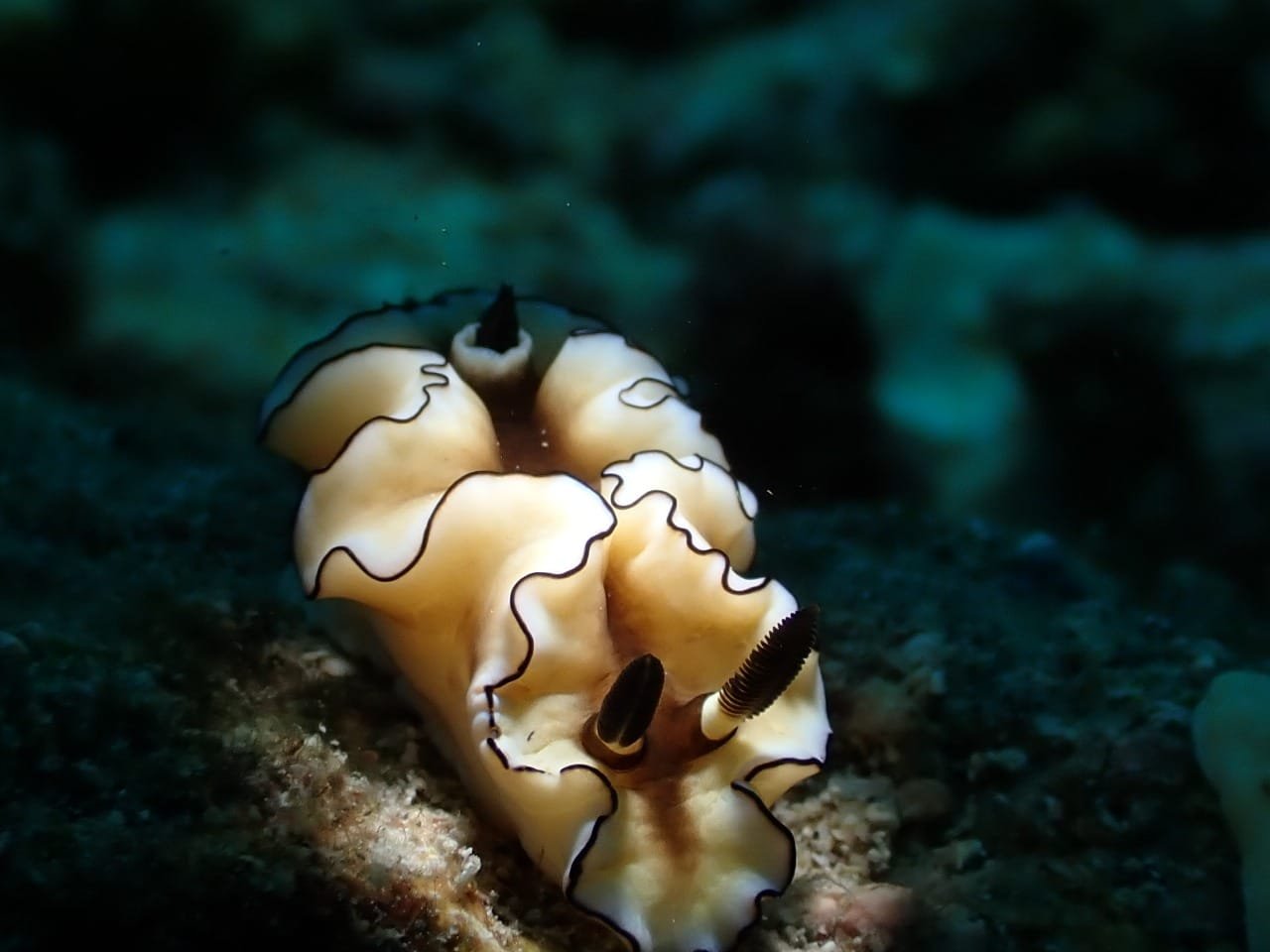
Doriprismatica atromarginata is one of the most immediately recognisable nudibranchs in the Indo-Pacific. Its large, smooth white mantle carries a bold dark brown to black band running continuously around the entire mantle edge — the defining feature that gives this species both its common and scientific names. Atro means black and marginata means bordered. Furthermore, the contrast between the white body and dark border is so striking that this species is visible from a considerable distance underwater, making it one of the easier nudibranchs to spot even without a macro lens.
Adults range from 20 to 80 mm in length, making this one of the larger dorid nudibranchs commonly encountered in Romblon. The mantle surface is smooth, with no tubercles or raised structures. The branchial plume consists of approximately 12–15 white gills surrounding the anal papilla. The rhinophores are white and lamellate. The oral tentacles are short and pointed. Some individuals show faint purple or grey tones on the mantle, and the width of the dark marginal band varies between individuals, but the basic pattern is always unmistakable.
Taxonomy note: Originally described as Chromodoris atromarginata by Eliot (1904). Turner & Gosliner (2016) moved the species to the new genus Doriprismatica following molecular phylogenetic analysis. The species was also formerly known as Glossodoris atromarginata. The accepted name today is Doriprismatica atromarginata (WoRMS AphiaID 597649).
Behaviour and Biology
Doriprismatica atromarginata feeds on dark-coloured encrusting sponges, which it locates by chemoreception using its rhinophores. Because it is a specialist sponge feeder, it is commonly found crawling directly on or near its food source. Moreover, it frequently aggregates in groups near productive sponge patches, and mating pairs are often observed in close proximity to feeding sites.
Unlike many nudibranchs that rely on camouflage, this species uses aposematic colouration — the bold white-and-dark contrast actively signals its unpalatability to predators. It sequesters toxic compounds from the sponges it consumes, making it distasteful or harmful to most fish. As a result, it moves openly across the reef at all hours, with no preference for day or night activity. Additionally, egg masses are frequently found near feeding aggregations, indicating year-round reproductive activity in Romblon’s warm tropical waters.
Distribution and Diving in Romblon
Throughout the Indo-Pacific, Doriprismatica atromarginata is one of the most widespread chromodorid nudibranchs. Records span the Red Sea, East Africa, the Indian Ocean, Southeast Asia, the Philippines, Indonesia, Japan, and the Pacific Islands. In Romblon specifically, it occurs from the shallows to approximately 25 metres on reef flats, slopes, and rubble zones wherever encrusting sponges are present.
At Sunset Cove Romblon, the Dark-Margined Nudibranch is one of the more commonly encountered nudibranch species and makes an excellent subject for underwater photographers and videographers of all experience levels. Search reef flats and slopes at 1–20m, paying attention to dark encrusting sponges. The bold dark margin makes the animal easy to spot from above. Its large size allows for full-body compositions showing the complete mantle outline and gill plume. Photograph from the side to capture the gill plume in profile. For taxonomy see WoRMS AphiaID 597649 and iNaturalist taxon 133090. Browse more species in our Marine Life Encyclopedia.
| Order | Nudibranchs (Nudibranchia) |
|---|---|
| Suborder | Doridina (Dorid Nudibranchs) |
| Family | Chromodorididae |
| Subfamily | Chromodoridinae |
| Genus | Doriprismatica |
| WoRMS AphiaID | 597649 |
| iNaturalist | 133090 |
| Size | 20–80 mm |
|---|---|
| Colour Variations | White body with distinctive dark brown to black marginal band around entire mantle edge; gills and rhinophores white; some individuals show faint purple or grey tones on mantle; dark margin width varies between individuals |
| Identifying Features | White body with bold dark brown or black band around mantle edge; white plumed gills; white rhinophores; relatively large size up to 80mm; smooth mantle surface; no tubercles or raised structures |
| Depth Range | 1–25 m (most common: 10 m) |
|---|---|
| Temperature | 24–30°C |
| Primary Prey / Host | Sponges (primarily dark-coloured encrusting sponges) |
| Seasonal Presence | Year-round |
|---|---|
| Egg Ribbon | White coiled ribbon deposited near host sponge |
| Spawning Season | Year-round — egg masses frequently found near feeding aggregations |
| Chemical Defence | Present |
| Aposematic Colouring | Present |
| Camouflage Strategy | None — aposematic colouration advertises toxicity; white and dark contrast is a warning signal |
| Escape Response | Chemical deterrents sequestered from sponge diet; slow crawl away from threat |