

coming
soon
coming
soon
The Tiger Butterfly Sea Slug
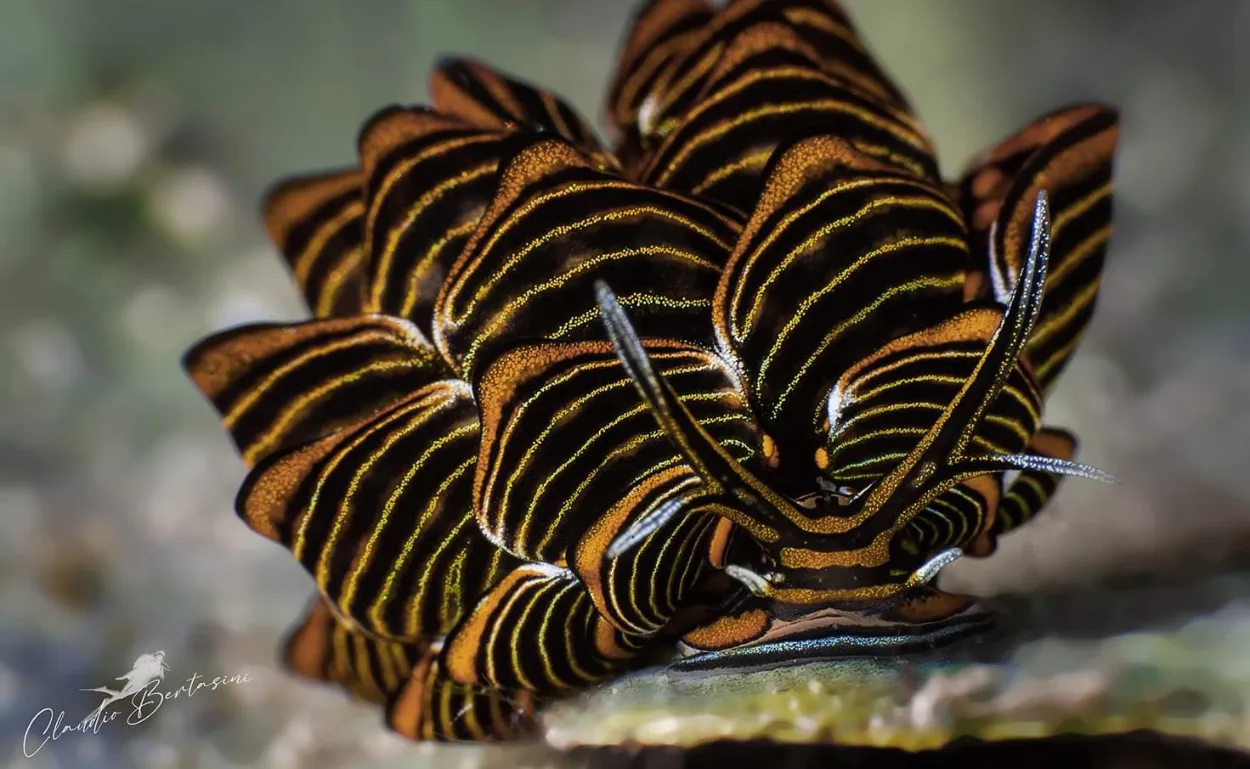
Cyerce nigra (Bergh, 1870) is one of the most striking sea slugs at our macro dive sites in Romblon, Philippines. Divers call it the Tiger Butterfly Sea Slug. Its bold black and white stripes on large leaf-like cerata make it easy to identify. It belongs to the order Sacoglossa, family Caliphyllidae. Furthermore, scientists documented it globally on iNaturalist. Its close relatives Cyerce blackburnae and Cyerce katiae are also documented in our Marine Life Encyclopedia.
A Remarkable Defence Strategy
Cyerce nigra feeds on green algae of the genus Udotea. It lives on sandy and rubble substrate at 3 to 25 metres depth. When a predator threatens it, the animal sheds its cerata. These cerata continue to writhe on the seafloor after separation. As a result, the predator attacks the moving cerata instead. Meanwhile, the animal escapes. This behaviour is called ceratal autotomy. In addition, its bold aposematic colouration warns predators of its chemical defence compounds.
Photographing It at Sunset Cove
At Sunset Cove Beach & Dive Resort, our guides regularly spot Cyerce nigra on sandy rubble near Udotea algae patches. It reaches 15 to 30 mm in length. Therefore, diopters and high magnification work best. Approach very slowly — it sheds its cerata immediately when startled. For underwater macro photographers in Romblon, the flapping cerata and tiger stripe pattern create outstanding images. Consequently, this species is one of the most popular subjects at our dive sites.
| Order | Sacoglossans (Sacoglossa) |
|---|---|
| Family | Caliphyllidae |
| Subfamily | Cyercinae |
| Genus | Cyerce |
| WoRMS AphiaID | 1814148 |
| iNaturalist | 840762 |
| Dive Sites | Canyon 1, Canyon 2 |
| Size | 15–30 mm |
|---|---|
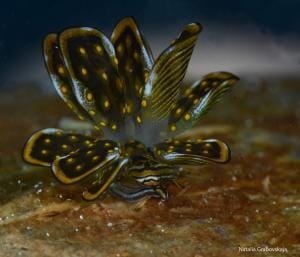
| Colour Variations | Dorsal cerata bear alternating black and white or yellow transverse stripes. Ventral surface shows vivid orange or yellow spots on a black background. Both surfaces edged in orange or yellow, framed by fine black and white marginal lines. Rhinophores share the same bold colouration in a subtly different pattern. Juveniles display identical colouration at very small size (under 5 mm). |
| Identifying Features | Large, flattened, leaf-like cerata with alternating black and white/yellow transverse stripes on the dorsal surface. Ventral surface has orange or yellow spots on black. Orange or yellow marginal edge with fine black and white lines. Bifurcate enrolled rhinophores with matching bold colouration. Easily confused with Cyerce nigricans — key difference: C. nigra has transverse stripes on cerata; C. nigricans has spots on both surfaces. |
| Substrate | sand, rubble |
|---|---|
| Depth Range | 3–25 m (most common: 10 m) |
| Temperature | 22–27°C |
| Primary Prey / Host | Udotea geppiorum (green alga) |
| Active Time | day, night |
|---|---|
| Seasonal Presence | Year-round |
| Egg Ribbon | White, coiled ribbon |
| Chemical Defence | Present |
| Aposematic Colouring | Present |
| Camouflage Strategy | Aposematic warning colouration — bold black, white and yellow stripes signal toxicity to predators |
| Escape Response | Ceratal autotomy — voluntarily sheds cerata which continue to writhe, distracting the predator while the animal escapes |