
coming
soon
coming
soon
coming
soon
coming
soon
A Newly Described Species
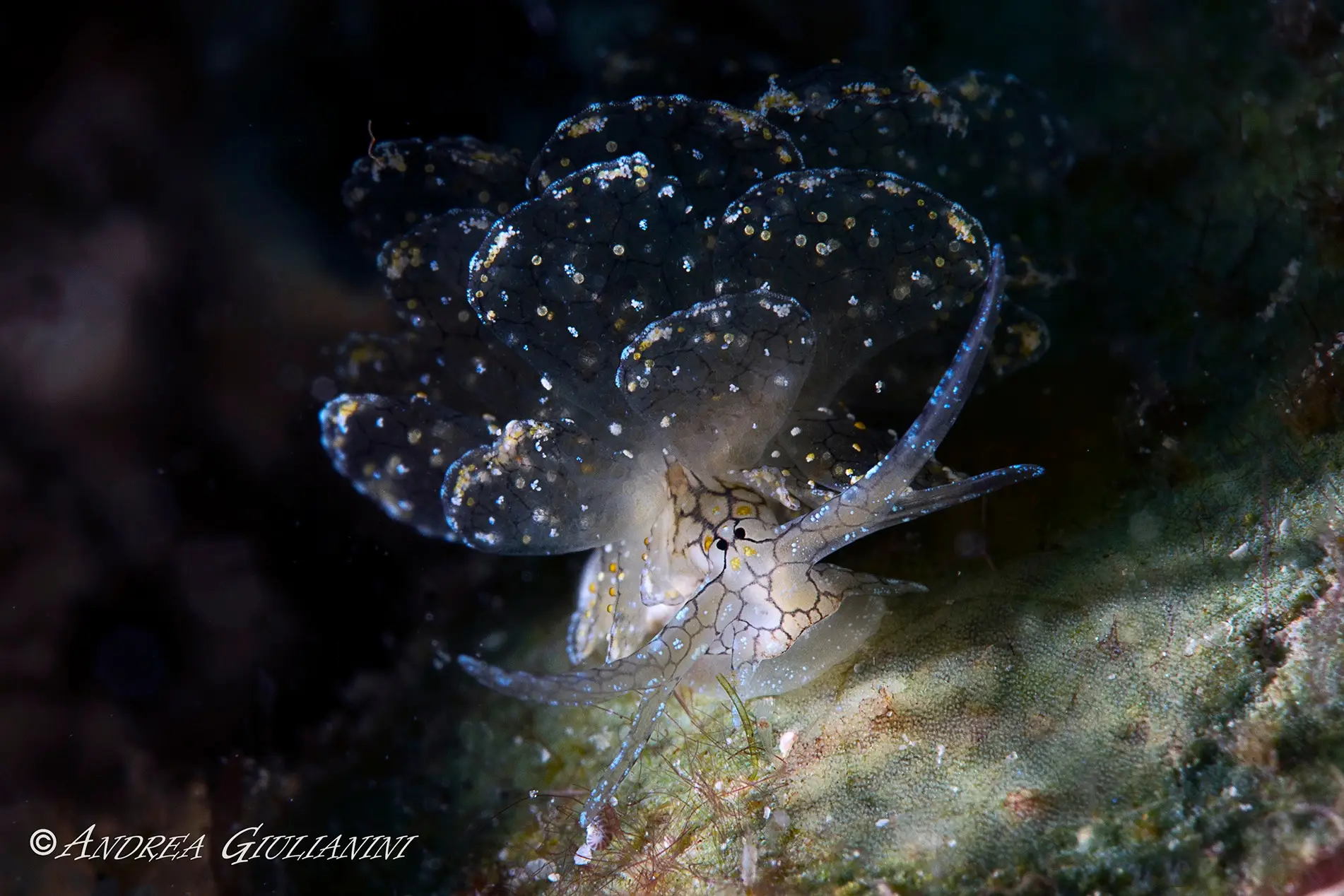
Cyerce katiae (Moreno, Gosliner, Wilson, Krug & Valdés, 2025) is one of the rarest butterfly sea slugs at our macro dive sites in Romblon, Philippines. Divers previously called it Cyerce sp. 4 or Cyerce sp. 4 (NSSI2). Scientists formally described it in 2025 as part of a major revision of the genus Cyerce. It belongs to the order Sacoglossa, family Caliphyllidae. Its close relatives Cyerce nigra and Cyerce blackburnae are also documented in our Marine Life Encyclopedia.
How It Defends Itself
Like all Cyerce species, Cyerce katiae has large, flattened, leaf-like cerata. These cerata carry a distinctive honeycomb pattern — hence its former dive community name. When a predator attacks, the animal sheds its cerata. The cerata continue to writhe after separation. As a result, the predator focuses on the moving cerata while the animal escapes. This defence is called ceratal autotomy. Furthermore, the species stores chemical compounds as an additional deterrent.
Finding It at Sunset Cove
At Sunset Cove Beach & Dive Resort, Cyerce katiae holds Epic rarity status. This means only one to three confirmed sightings exist at our dive sites. Our guides search sandy rubble substrate near Udotea algae patches at depth. The animal is tiny — just 5 to 15 mm. Therefore, it requires maximum magnification and a very slow approach. For underwater macro photographers in Romblon, spotting this species is one of the most exciting encounters possible on any dive.
| Order | Sacoglossans (Sacoglossa) |
|---|---|
| Family | Caliphyllidae |
| Subfamily | Cyercinae |
| Genus | Cyerce |
| WoRMS AphiaID | 1814153 |
| iNaturalist | 1623583 |
| Size | 5–15 mm |
|---|---|
| Colour Variations | Body translucent to white. Cerata bear a distinctive honeycomb or reticulated pattern. Previously documented under the informal name Cyerce sp. 4 or Cyerce sp. 4 (NSSI2) by the diving community before formal description in 2025. Exact colour pattern distinguishes it from related species including Cyerce nigra and Cyerce blackburnae. |
| Identifying Features | Distinguished by its honeycomb or reticulated pattern on the cerata — hence the former dive community name Honeycomb Butterfly Sea Slug. Large flattened leaf-like cerata typical of genus. Bifurcate enrolled rhinophores. Best identified by habitat association with Udotea algae and comparison with known specimen photographs. Formally distinguished from other Cyerce species through molecular (COI, 16S, H3) and penial anatomy analysis. |
| Depth Range | 5–40 m (most common: 20 m) |
|---|---|
| Temperature | 24–28°C |
| Primary Prey / Host | Udotea spp. (green algae) |
| Seasonal Presence | Year-round — very rarely encountered |
|---|---|
| Egg Ribbon | White, coiled ribbon |
| Chemical Defence | Present |
| Aposematic Colouring | Absent |
| Camouflage Strategy | Honeycomb reticulated pattern on cerata provides cryptic camouflage on Udotea algae substrate. |
| Escape Response | Ceratal autotomy — voluntarily sheds cerata which continue to writhe, distracting predators while the animal escapes. |
-
Phylogenetic systematics of the genus Cyerce Bergh, 1870 (Sacoglossa, Caliphyllidae) with descriptions of nine new species
Moreno, K.; Medrano, S.; Gosliner, T.M.; Wilson, N.G.; Krug, P.J.; Valdés, Á. (2025)