
coming
soon
coming
soon
coming
soon
coming
soon
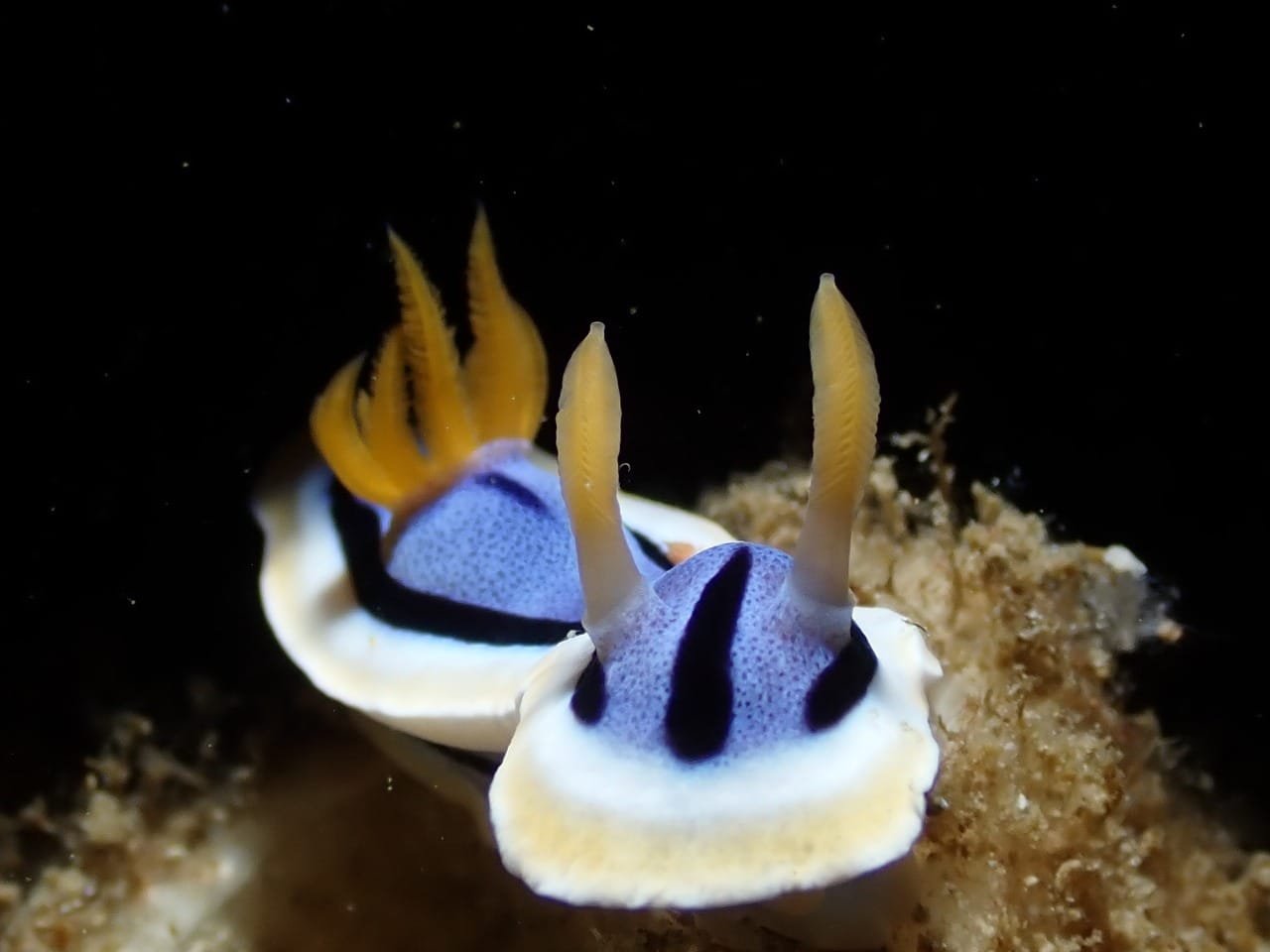
Chromodoris lochi is one of the most recognisable nudibranchs on Romblon’s coral reefs. Divers know it as Loch’s Chromodoris. William Rudman first described this species in 1982. It belongs to the family Chromodorididae — the same family as Goniobranchus reticulatus and Doriprismatica atromarginata, both documented in our Marine Life Encyclopedia. Furthermore, it ranks among the most frequently photographed nudibranchs across the Indo-Pacific, making it an ideal subject for macro photography diving in Romblon.
Appearance and Identification
Chromodoris lochi displays a blue or bluish-white mantle with a clean white border. Dark or black longitudinal lines run down the mantle and the foot. A continuous line traces the outer edge of the mantle, passing outside the rhinophores. A second, often discontinuous median line runs along the centre. The gills and rhinophores range from translucent straw-yellow through to pink and light orange. Individuals reach at least 40 mm in length. This species closely resembles Chromodoris willani, Chromodoris dianae, and Chromodoris boucheti. However, the uniform mantle colouring and absence of white specks help distinguish C. lochi from these similar species. Moreover, recent molecular studies suggest that more than one cryptic species is currently grouped under this name.
Behaviour and Biology
Like all Chromodorididae, Chromodoris lochi is a specialist sponge predator. It feeds specifically on sponges from the family Thorectidae, including Cacospongia mycofijiensis and Semitaspongia species. Additionally, it is hermaphroditic and mates by mutual sperm exchange. It lays eggs in a spiral ribbon typical of dorid nudibranchs. As a result of feeding on toxic sponges, it accumulates chemical defences that make it unpalatable to most predators — a trait common across the Chromodorididae family.
Diving with Chromodoris lochi in Romblon
Our guides find Chromodoris lochi regularly on sponge-encrusted reef walls and rubble slopes around Alad Island. It typically occurs between 5 and 25 metres depth — well within recreational diving range. Furthermore, its bold colouring and moderate size make it an excellent macro photography subject for both beginners and experienced underwater photographers. Consult the WoRMS species page and the iNaturalist taxon page for further identification references.
| Suborder | Doridina (Dorid Nudibranchs) |
|---|---|
| Family | Chromodorididae |
| Subfamily | Chromodoridinae |
| Genus | Chromodoris |
| WoRMS AphiaID | 558198 |
| iNaturalist | 201640 |
| Size | Up to 40 mm |
|---|---|
| Identifying Features | Blue/bluish-white mantle with white margin. Dark longitudinal lines on mantle and foot. Gills and rhinophores from straw-yellow to pink/orange. No white specks on mantle. |