
Identification and Appearance
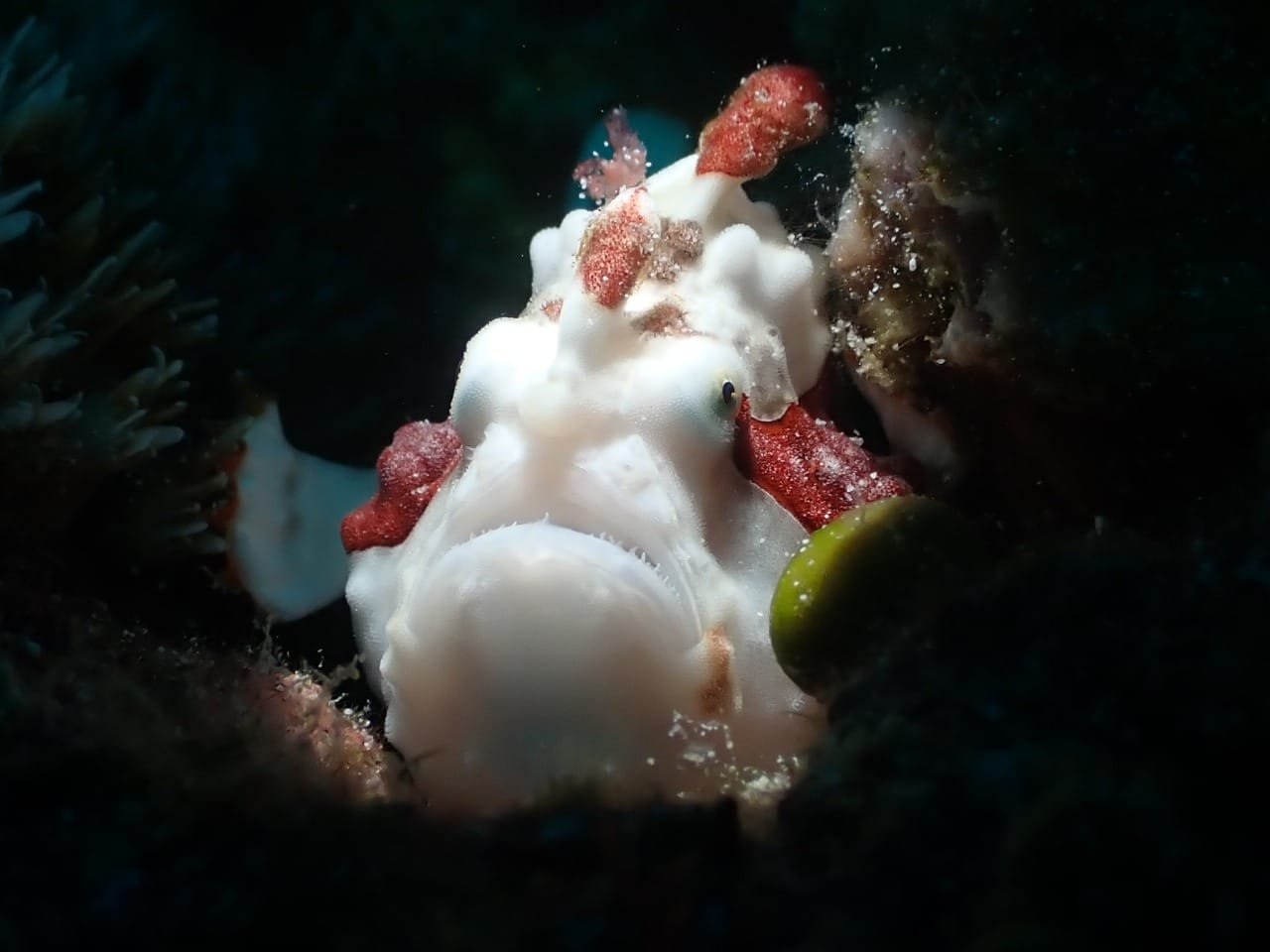
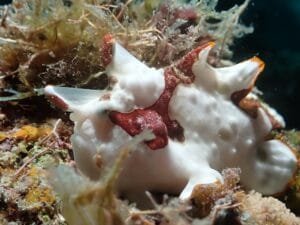
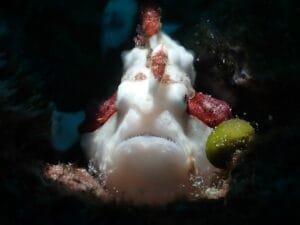
Antennarius maculatus is one of the most extraordinary fish on the reef. The Clown Frogfish combines perfect camouflage with a built-in fishing rod — the first dorsal spine has evolved into a long, flexible illicium tipped with a fleshy lure called an esca. The animal dangles this lure above its enormous upward-facing mouth to attract prey. Furthermore, the entire body is covered in warty dermal spinules that break up its outline against sponges, algae, and rubble.
Adults reach 50–100 mm in length. Colour varies enormously — individuals appear white, yellow, orange, red, pink, brown, or black. All forms carry irregular dark spots or blotches. Importantly, the colour is not fixed. Over days or weeks, A. maculatus slowly shifts its pigmentation to match a new background after relocating. The arm-like pectoral and pelvic fins allow it to walk across the substrate rather than swim. The mouth is highly distensible and can open wide enough to swallow prey nearly equal to the frogfish’s own body size.
Taxonomy note: Described by Desjardins (1840). The species name maculatus means spotted. Also known as Warty Frogfish in some references. WoRMS AphiaID 218676 is the accepted name. The family Antennariidae contains all true frogfishes.
Behaviour and Biology
Antennarius maculatus is an ambush predator. It sits motionless on the substrate and waves its lure to attract small fish and crustaceans within striking range. Then, with one of the fastest strikes in the animal kingdom — taking as little as 6 milliseconds — it engulfs the prey whole. Because its stomach can expand dramatically, it targets prey up to its own body size.
The species is solitary and territorial. It rarely moves unless hunting or relocating to a new ambush site. When threatened, it inflates its body with water and may use jet propulsion by expelling water through small gill openings behind the pectoral fins. In addition, females release a large gelatinous egg raft at night containing thousands of eggs. The egg raft floats at the surface until the larvae hatch.
Distribution and Diving in Romblon
Throughout the Indo-Pacific, Antennarius maculatus occupies rocky reef, rubble, and sponge-encrusted substrate from 1 to 40 metres depth. Records span the Red Sea, East Africa, the Indian Ocean, Southeast Asia, the Philippines, Indonesia, Japan, and Australia. In Romblon, it favours reef slopes and rubble zones with abundant sponge growth between 5 and 30 metres.
At Sunset Cove Romblon, the Clown Frogfish is a prized sighting for underwater photographers and videographers. To find one, search slowly over sponge-covered rubble and reef slopes at 5–30m. Do not look for a specific colour — instead, look for the warty texture and arm-like pectoral fins. Watch for the illicium waving above the head, as this movement often gives the animal away first. Approach very slowly and avoid repeatedly disturbing the animal, since stressed frogfish relocate and become much harder to find again. Wide macro compositions showing the full body with the lure visible produce the most striking results. For taxonomy see WoRMS AphiaID 218676 and iNaturalist taxon 64248. Browse more species in our Marine Life Encyclopedia.
| Order | Frogfish (Lophiiformes) |
|---|---|
| Family | Antennariidae |
| Subfamily | Antennariinae |
| Genus | Antennarius |
| WoRMS AphiaID | 218676 |
| iNaturalist | 119392 |
| Size | 50–100 mm |
|---|---|
| Colour Variations | Highly variable — white, yellow, orange, red, pink, brown, or black; always with irregular dark spots or blotches; skin covered in warty dermal spinules giving a rough texture; colour can change slowly to match surroundings |
| Identifying Features | Warty textured body with irregular dark spots and blotches; first dorsal spine modified into fishing lure (illicium) tipped with fleshy esca; large upward-facing mouth; pectoral fins arm-like for walking on substrate; second and third dorsal spines close-set |
| Depth Range | 1–40 m (most common: 15 m) |
|---|---|
| Temperature | 24–30°C |
| Primary Prey / Host | Small fish and crustaceans (aggressive ambush predator) |
| Seasonal Presence | Year-round |
|---|---|
| Egg Ribbon | Gelatinous egg raft (veil) containing thousands of eggs, released at night |
| Spawning Season | Unknown — females release egg raft (veil of eggs) at night |
| Chemical Defence | Absent |
| Aposematic Colouring | Absent |
| Camouflage Strategy | Extraordinary colour and texture matching to surroundings — sponges, algae, rubble; warty skin breaks body outline; one of the best-camouflaged fish on the reef |
| Escape Response | Relies on camouflage; inflates body with water if grabbed; jet propulsion by expelling water through small gill openings |