
coming
soon
coming
soon
coming
soon
coming
soon
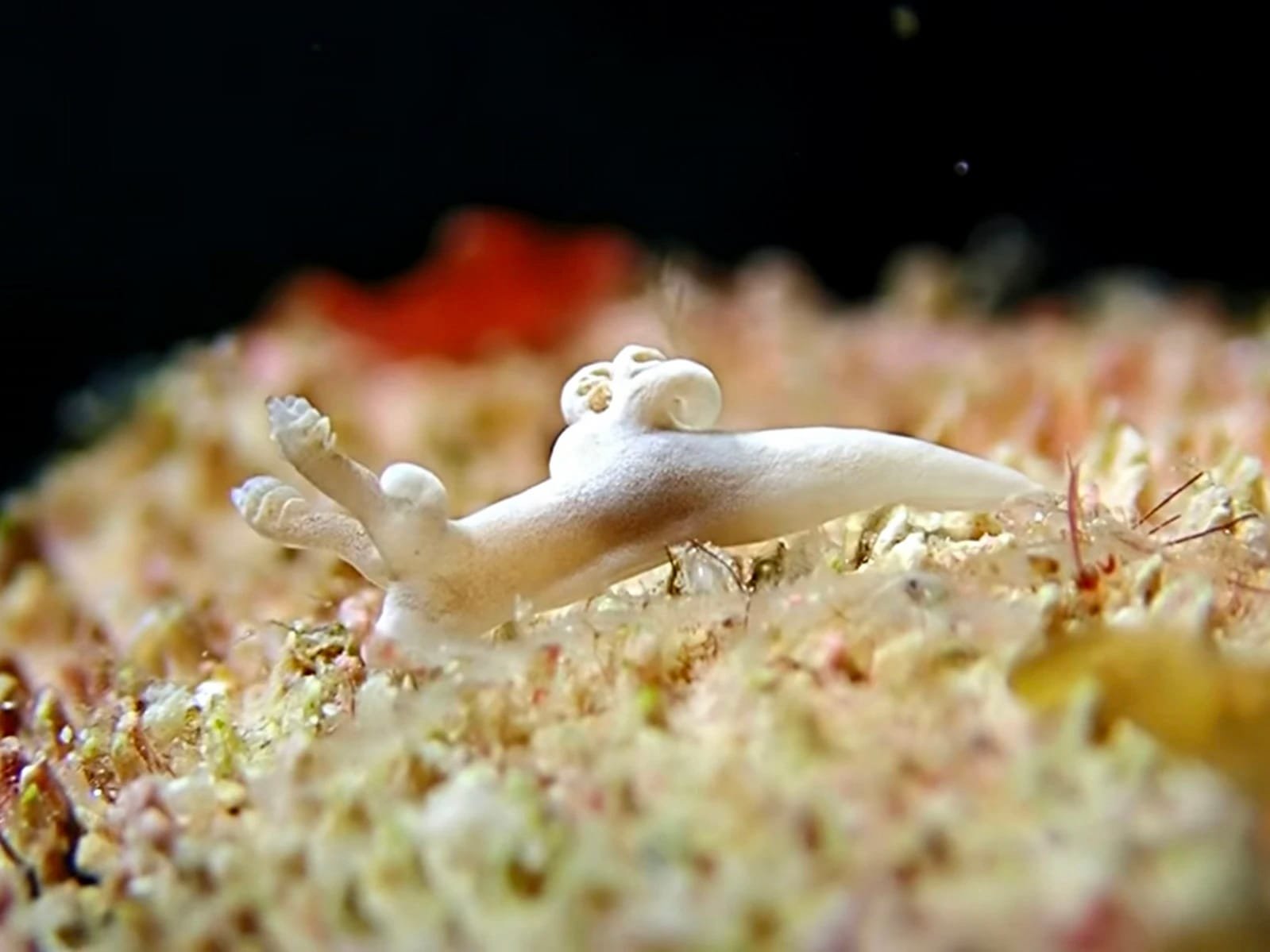
Trapania lemnalioides is one of the most distinctive and rarely photographed nudibranchs in the Indo-Pacific. It belongs to the genus Trapania — a group of goniodorid nudibranchs immediately recognisable by their two pairs of elongated lateral papillae, one pair flanking the rhinophores and one pair flanking the gill cluster. These papillae give Trapania species an unmistakable silhouette unlike any other nudibranch. Finding Trapania lemnalioides in Romblon is therefore a genuinely exceptional event — each sighting is scientifically significant. It feeds exclusively on entoprocts, a group of tiny sessile invertebrates that grow on sponges and other hard substrates. Visit our macro photography dive sites in Romblon for the best chance of an encounter.
Appearance and Identification
Trapania lemnalioides is a small nudibranch typically measuring 8–15mm. The body is translucent white to pale cream, often with scattered orange or yellow pigment spots on the head, body, and appendages. The rhinophores are smooth and club-shaped. The gills form a small cluster around the anus. Furthermore, the two pairs of elongated lateral papillae are the key identification feature — they extend backwards parallel to the body axis and are tipped with contrasting colour. In addition, the oral tentacles are well developed and prominent. The overall appearance is delicate and almost otherworldly. Separating it from other Trapania species requires careful attention to the colour and patterning of the lateral papillae tips and the body pigmentation.
Habitat and Biology
Trapania lemnalioides feeds exclusively on entoprocts — tiny colonial filter feeders that grow attached to sponges, bryozoans, and other hard substrates on the reef. This highly specialised diet means the nudibranch is always found close to entoproct colonies, which are themselves microscopic and difficult to see. Moreover, because entoprocts are so tiny, Trapania nudibranchs are rarely found in large numbers at any one site. The species has been recorded from the Philippines and the broader Western Pacific. Consequently, Romblon sits within its known range and our macro reef slopes provide ideal habitat.
Diving with Trapania lemnalioides in Romblon
Look for Trapania lemnalioides on silty rubble, reef walls, and on encrusting sponge at 10–25 metres. Its small size means it is easy to miss — a slow, methodical search at very low speed is essential. Because it feeds on entoprocts growing on sponges, focus your search on patches of encrusting sponge. Macro lenses at 1:1 or greater are necessary to capture its full detail. Submit your sighting to the iNaturalist taxon page to contribute to distribution mapping. Full taxonomy is available on the WoRMS species page. Explore more species in our Romblon Critter Encyclopedia.
| Suborder | Doridina (Dorid Nudibranchs) |
|---|---|
| Family | Goniodorididae |
| Genus | Trapania |
| WoRMS AphiaID | 1580696 |
| iNaturalist | 1441015 |
| Identifying Features | Small 8-15mm. Translucent white to pale cream body. Orange or yellow pigment spots on head and body. Two pairs of elongated lateral papillae extending backwards parallel to body — key genus feature. Smooth club-shaped rhinophores. Well-developed oral tentacles. |
|---|
| Depth Range | 10–25 m |
|---|---|
| Primary Prey / Host | Entoprocts (sessile colonial invertebrates growing on sponges) |