
coming
soon
coming
soon
Identification and Appearance
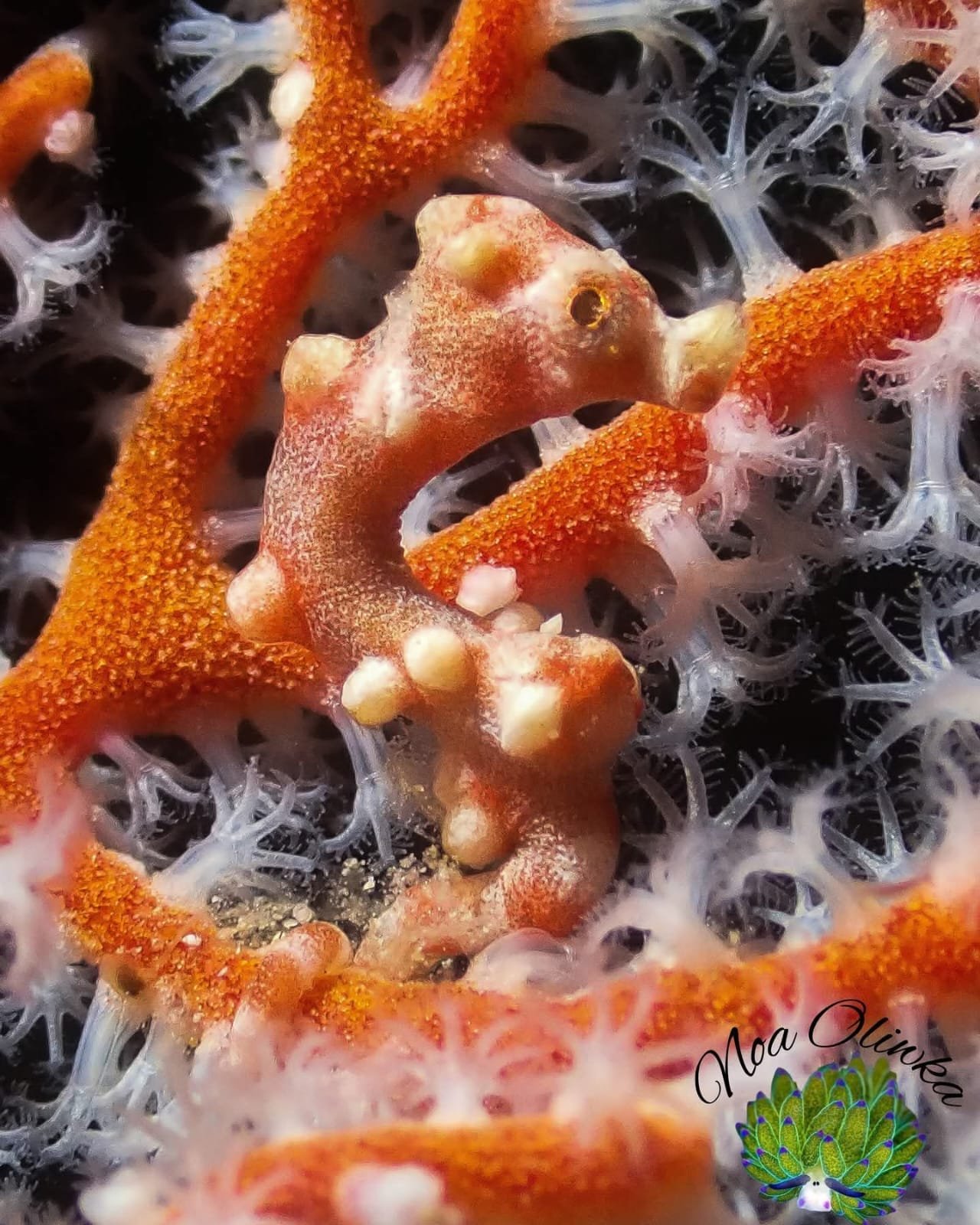
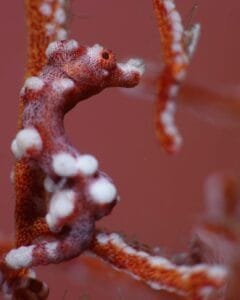
Hippocampus denise is one of the smallest seahorses on Earth, reaching just 13–24 mm in length. What makes this species extraordinary, however, is not its size alone — it is the near-perfect mimicry of its host gorgonian sea fan. The body surface carries fine rounded tubercles that precisely match the texture and colour of the coral polyps it lives among. As a result, even experienced divers routinely fail to spot this animal despite looking directly at its host.
Body colour varies from yellow-orange to orange-red, always closely matching the host gorgonian. Occasionally, pale cream individuals appear on lighter-coloured hosts. The coronet — the bony crown on top of the head — is distinctly small. The snout is shorter than in Hippocampus bargibanti, which helps separate the two species. Furthermore, H. denise has fewer tubercles overall and typically occurs at greater depths than H. bargibanti.
Taxonomy note: Described by Lourie & Randall (2003) from specimens collected in Fiji and Indonesia. Named after Denise Nielsen Tackett, an underwater photographer and marine author. The accepted WoRMS AphiaID is 272995. The species is closely related to H. bargibanti but represents a distinct species based on morphology, host preference, and depth range.
Behaviour and Biology
Hippocampus denise spends its entire life on a single gorgonian sea fan, rarely if ever leaving. It feeds on small crustaceans and copepods that drift past in the current, using its tube-like snout to ambush prey. Because gorgonians grow on current-swept walls where food availability is high, this strategy is highly effective despite the animal’s tiny size.
Like all seahorses, the male carries the developing young in a ventral brood pouch. The species is typically solitary or found in pairs on a single host coral. Moreover, it is most active during daylight hours and relies entirely on crypsis for defence — gripping the gorgonian branches with its prehensile tail and remaining completely motionless when threatened.
Distribution and Diving in Romblon
Throughout the central Indo-Pacific, Hippocampus denise occurs wherever suitable gorgonian habitat exists, typically between 13 and 90 metres depth. It has been recorded from Indonesia, the Philippines, Fiji, Papua New Guinea, and surrounding reef systems. In particular, it favours steep walls and slopes where large gorgonian sea fans of the genus Muricella and related genera grow in moderate to strong current.
At Sunset Cove Romblon, Denise’s Pygmy Seahorse ranks among the most coveted macro diving finds for underwater photographers and videographers. Search gorgonian sea fans systematically at 15–50m on current-swept walls. Scan slowly across the entire fan surface and look for the distinctive snout profile breaking the outline of the coral branches. Orange-red individuals on orange sea fans are the most common find. Use high magnification, shoot perpendicular to the fan, and keep buoyancy precise — any surge makes sharp focus at this scale very difficult. For taxonomy see WoRMS AphiaID 272995 and iNaturalist taxon 102818. Browse more species in our Marine Life Encyclopedia.
| Order | Seahorses & Pipefishes (Syngnathiformes) |
|---|---|
| Suborder | Syngnathidae (Seahorses & Pipefishes) |
| Family | Syngnathidae |
| Subfamily | Hippocampinae |
| Genus | Hippocampus |
| WoRMS AphiaID | 272995 |
| iNaturalist | 102818 |
| Size | 13–24 mm |
|---|---|
| Colour Variations | Yellow-orange to orange-red body matching host gorgonian; colour matches host coral precisely; occasional pale cream individuals on lighter hosts |
| Identifying Features | Extremely small (13–24mm); body covered in rounded tubercles matching gorgonian polyps; no distinct skin flaps; colour matches host gorgonian; lives exclusively on gorgonian sea fans; differentiated from H. bargibanti by smaller size, fewer tubercles, and deeper habitat |
| Depth Range | 13–90 m (most common: 25 m) |
|---|---|
| Temperature | 24–30°C |
| Primary Prey / Host | Small crustaceans, copepods |
| Seasonal Presence | Year-round |
|---|---|
| Egg Ribbon | N/A — male broods young internally in ventral pouch |
| Spawning Season | Unknown — likely year-round in tropical waters |
| Chemical Defence | Absent |
| Aposematic Colouring | Absent |
| Camouflage Strategy | Body colour and tubercle pattern precisely match host gorgonian polyps; effectively invisible when stationary on host coral |
| Escape Response | Relies entirely on crypsis; grips gorgonian branches with prehensile tail; remains motionless |