
coming
soon
coming
soon
coming
soon
coming
soon
Identification and Appearance
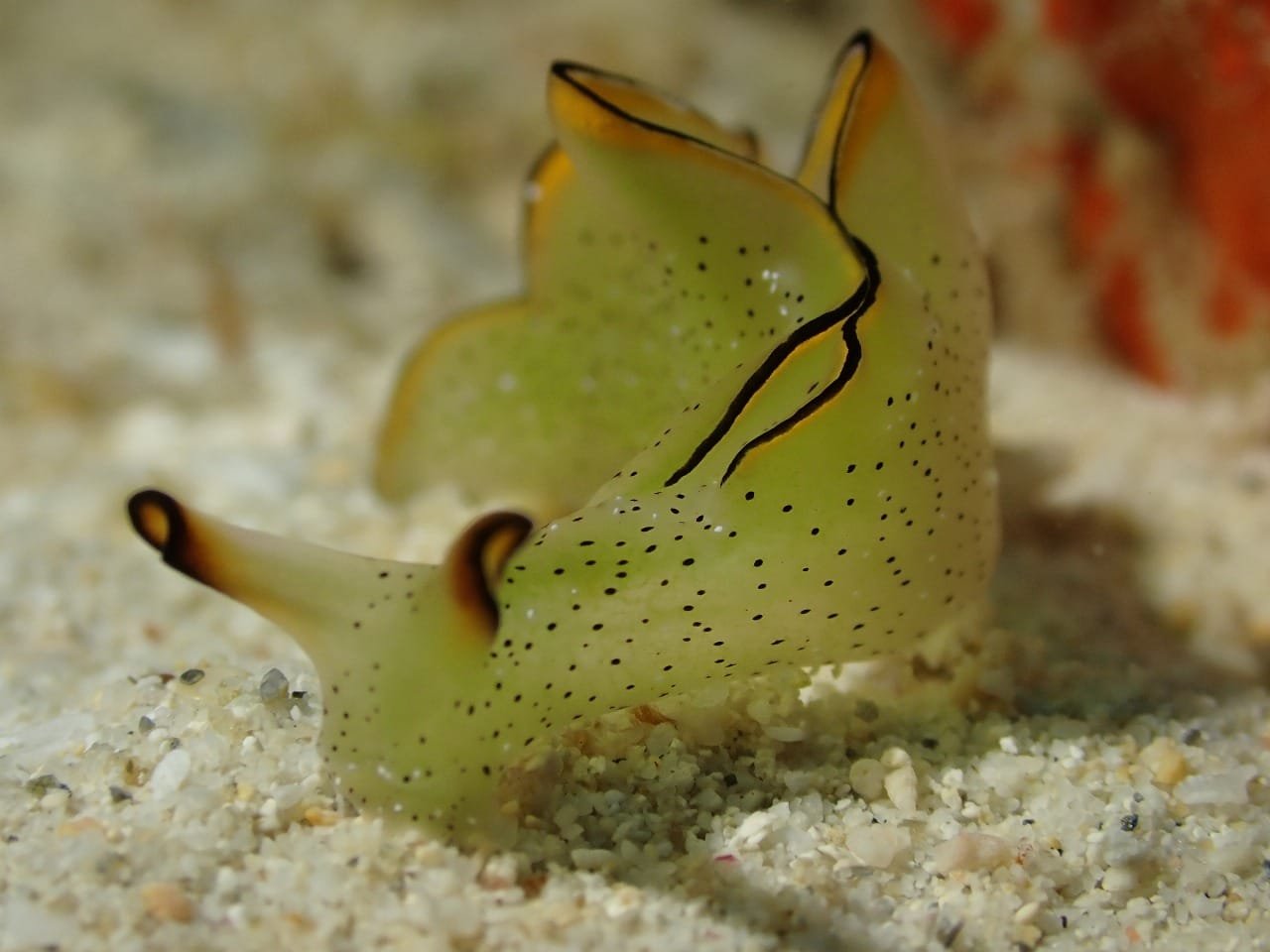
Elysia marginata is a striking sacoglossan sea slug. Its body is translucent green and covered in scattered black and cream spots. The parapodia are tall and thin. They fold over the body like wings to maximise light absorption.
The parapodial edge has three colour bands. First, a bold black margin runs along the outer edge. Second, a submarginal orange band sits just inside it. Third, a narrow white band separates the orange from the black. This white band is the key identification feature for Elysia marginata in the Indo-Pacific.
Two body forms exist. The sedentary form reaches up to 76mm. In contrast, the migratory form rarely exceeds 25mm. Additionally, a faint transverse groove runs across the neck. This groove is the animal’s built-in autotomy breakage plane.
Behaviour and Biology
Elysia marginata feeds on Bryopsis spp. green algae using a suctorial mouth. Rather than digesting the chloroplasts it ingests, it stores them intact inside its digestive cells. These stolen chloroplasts continue to photosynthesise inside the slug’s body. As a result, the animal gains a supplemental solar-powered energy source.
This kleptoplasty ability plays a key role in the species’ most extreme defence. When parasitised, Elysia marginata severs its own head from the rest of its body. The separation happens slowly at the neck groove over several hours. Remarkably, the head survives without a heart or digestive organs. Instead, it runs entirely on chloroplast energy. Within approximately three weeks, it regenerates a complete new body.
Scientists at Nara Women’s University documented this in a 2021 Current Biology study. They described it as the most extreme autotomy ever recorded in the animal kingdom. Furthermore, one individual in the study shed and regrew its body twice.
Distribution and Diving in Romblon
Elysia marginata is widely distributed across the Indo-Pacific. It has been recorded in the Philippines, Japan, Indonesia, Hawaii, Fiji, and Australia. It lives in shallow intertidal and subtidal zones from 0 to 10 metres. Typically, it grazes on Bryopsis algae on rubble slopes and reef edges.
At Sunset Cove Romblon, this species appears year-round in shallow macro zones. For underwater photographers and videographers, the three-band parapodial pattern makes it visually distinctive. However, the migratory form is much smaller and requires a careful eye. Shoot at a flat angle to capture the white band in full detail. This gives you the clearest identification shot.
For taxonomy and global sightings, see WoRMS AphiaID 765107 and iNaturalist taxon 546397. Browse more species in our Marine Life Encyclopedia.
| Order | Sacoglossans (Sacoglossa) |
|---|---|
| Family | Plakobranchidae (Leaf Slugs / Cyerce) |
| Genus | Elysia |
| WoRMS AphiaID | 765107 |
| iNaturalist | 546397 |
| Size | 15–76 mm |
|---|---|
| Colour Variations | Green body with black and cream/white spots; black parapodial margin; orange submarginal band; white band between orange and black |
| Identifying Features | Tall thin parapodia with black edge, submarginal orange band, distinctive white band between orange and black margins; black and cream spots throughout body |
| Depth Range | Up to 10 m (most common: 3 m) |
|---|---|
| Temperature | 24–30°C |
| Primary Prey / Host | Bryopsis spp. (green algae) |
| Seasonal Presence | Year-round |
|---|---|
| Egg Ribbon | White coiled ribbon |
| Spawning Season | Unknown |
| Chemical Defence | Present |
| Aposematic Colouring | Absent |
| Camouflage Strategy | Cryptic green colouration matches Bryopsis algae host; kleptoplasts in tissues create photosynthetic solar-powered appearance |
| Escape Response | Extreme autotomy — severs head from body at transverse neck groove; head survives and regenerates full new body within weeks |