
coming
soon
coming
soon
coming
soon
coming
soon
A Sea Slug That Kept Its Shell
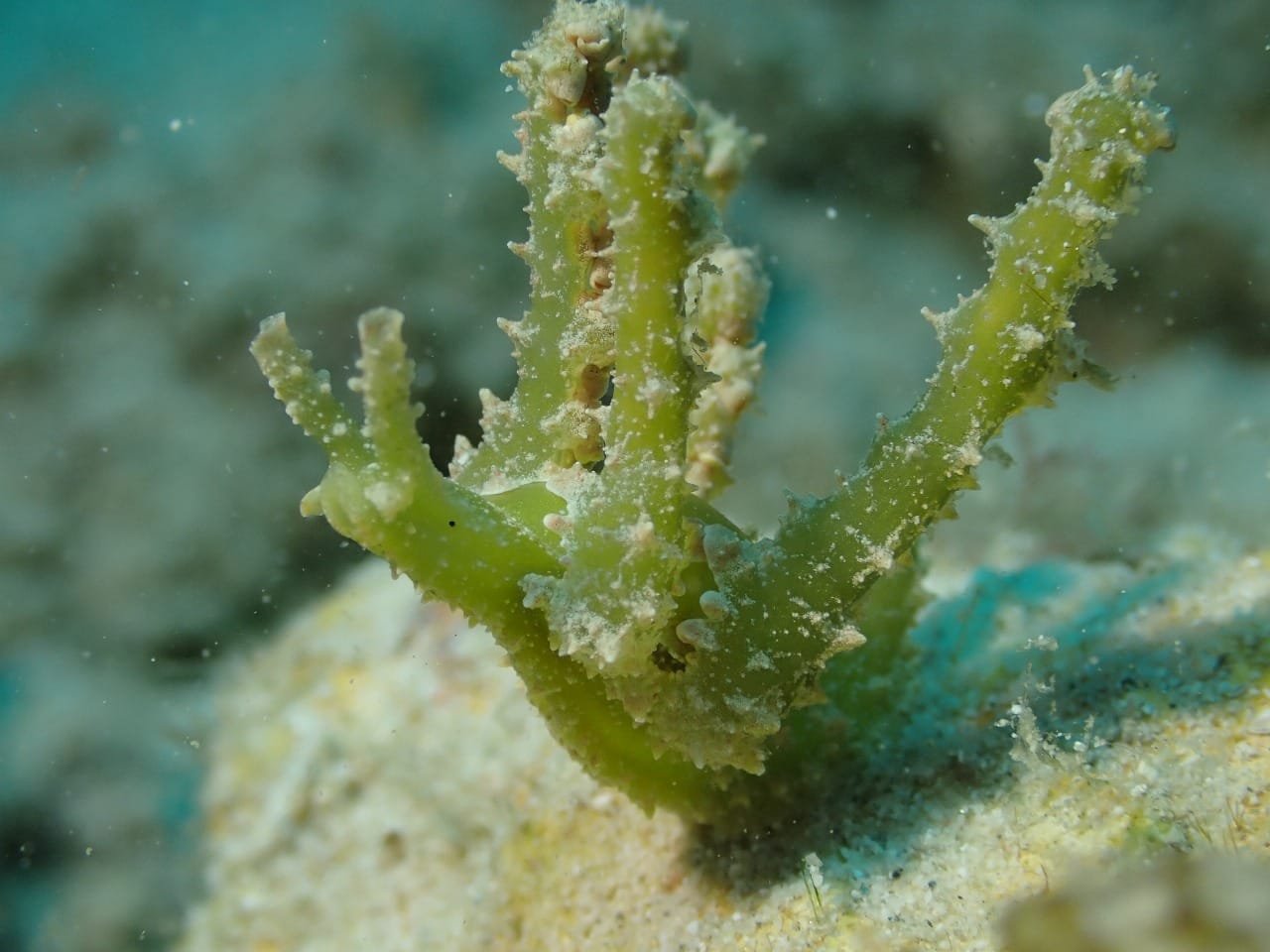
Lobiger viridis (Pease, 1863) is one of the most extraordinary sea slugs at our macro dive sites in Romblon, Philippines. Most sea slugs have lost their shell entirely during evolution. Lobiger viridis has not. It retains a small internal spiral shell — making it one of the most primitive sacoglossans alive today. Furthermore, it has four long wing-like parapodial flaps that unfurl to display bright colour patches. It belongs to the order Sacoglossa, family Oxynoidae — a different family from all other Cyerce species in our Marine Life Encyclopedia. Find it on iNaturalist.
Solar Powered on Caulerpa
Lobiger viridis feeds by piercing Caulerpa green algae cells and sucking the sap. It retains the functional chloroplasts from the algae in its digestive gland cells. These chloroplasts continue to photosynthesise inside the animal. As a result, Lobiger viridis gains supplementary energy directly from sunlight — a process called kleptoplasty. Its bright green body provides perfect camouflage on Caulerpa. In addition, when threatened, it unfurls its parapodial flaps to display bright warning colours and appear larger to predators. It can even swim weakly by flapping these wings if dislodged from the algae.
Finding It at Sunset Cove
At Sunset Cove Beach & Dive Resort, our guides find Lobiger viridis on Caulerpa algae patches in very shallow water — typically 1 to 5 metres. The green body blends perfectly with the algae. Therefore, search slowly for the distinctive rolled parapodial flaps along the body sides. For underwater macro photographers in Romblon, photographing the unfurled parachute-like flaps creates one of the most unique images possible from any dive site. Consequently, this species is one of the most exciting and unusual sacoglossans in our entire encyclopedia.
| Order | Sacoglossans (Sacoglossa) |
|---|---|
| Family | Oxynoidae |
| Genus | Lobiger |
| WoRMS AphiaID | 494421 |
| iNaturalist | 418363 |
| Size | 10–30 mm |
|---|---|
| Colour Variations | Body bright green matching Caulerpa algae. Four long wing-like parapodia (parapodial flaps) which when unrolled display bright coloured patches — typically yellow, orange or white with green mottling. The parapodia serve as both camouflage and a remarkable display when unfurled. Body retains a small internal spiral shell — unique among sacoglossans at Romblon — making Lobiger viridis one of the most unusual sea slugs in the encyclopedia. |
| Identifying Features | Instantly recognisable by its four long parapodial flaps which unfurl like wings. Bright green body matches Caulerpa algae precisely. Internal shell retained — unlike all other sacoglossans in our encyclopedia. Always found on Caulerpa algae in very shallow water. The unfurled parapodia display bright colour patches unique to this species. Distinguished from all Cyerce species by having parapodial flaps rather than leaf-like cerata. One of very few sacoglossans worldwide to retain the ancestral gastropod shell. |
| Substrate | sand, rubble |
|---|---|
| Depth Range | 1–15 m (most common: 5 m) |
| Temperature | 24–29°C |
| Primary Prey / Host | Caulerpa spp. (green algae, family Caulerpaceae) — retains chloroplasts for photosynthesis |
| Active Time | day, night |
|---|---|
| Seasonal Presence | Year-round — found on Caulerpa algae in shallow water |
| Egg Ribbon | White, coiled ribbon deposited on Caulerpa |
| Spawning Season | Not yet documented at SSC |
| Chemical Defence | Absent |
| Aposematic Colouring | Absent |
| Camouflage Strategy | Bright green body provides excellent camouflage on green Caulerpa algae. When threatened, may unfurl parapodial flaps to display warning coloration and appear larger. The rolled parapodia add to the algae-like appearance when closed. |
| Escape Response | Unfurls parapodial flaps as warning display. Can swim weakly by flapping parapodia if dislodged from substrate. No ceratal autotomy — different defence strategy from Cyerce species. |
-
Sacoglossa (Mollusca: Gastropoda: Heterobranchia) from northern coasts of Singapore
Jensen, K. (2015). Raffles Bulletin of Zoology, suppl. 31: 226–249