
coming
soon
coming
soon
coming
soon
A Pink Icon Reclaims Its Name
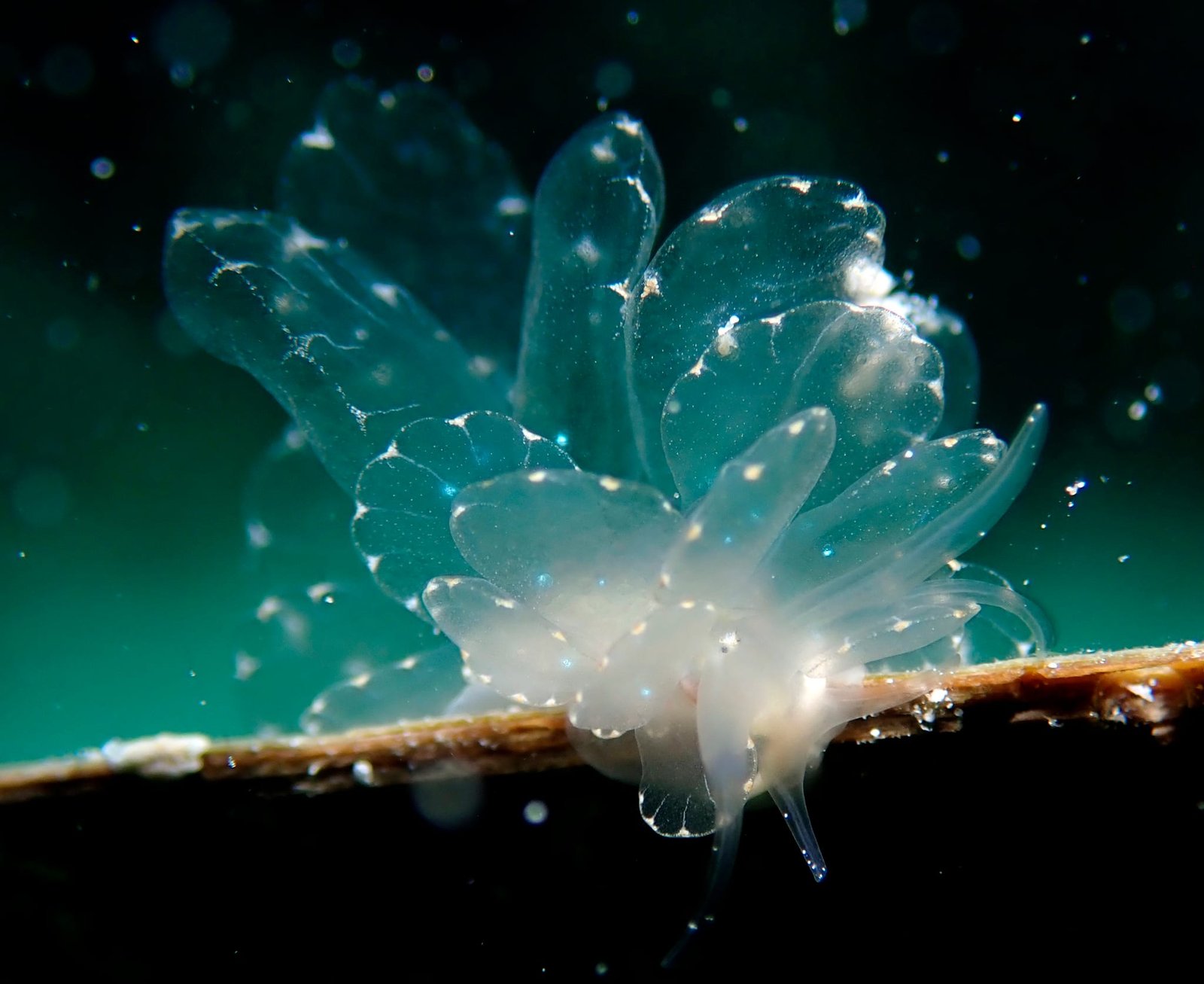
Cyerce elegans (Bergh, 1870) is one of the most visually striking butterfly sea slugs at our macro dive sites in Romblon, Philippines. Its body and large leaf-like cerata are a bold, unmistakeable pink. Furthermore, it has a fascinating taxonomic story. For decades, the dive community called this pink species Cyerce sp. 3 or Cyerce sp. 3 (NSSI2). Meanwhile, a different golden species incorrectly carried the name C. elegans. The landmark 2025 molecular revision by Moreno et al. set the record straight — the true Cyerce elegans is this pink species. It belongs to the order Sacoglossa, family Caliphyllidae, and is documented on iNaturalist.
Bold Colour, Bold Defence
Unlike most Cyerce species, Cyerce elegans does not hide. Its pink colouration is aposematic — it warns predators of chemical defence compounds in its body tissue. In addition, like all Cyerce, it performs ceratal autotomy when threatened. The cerata detach and writhe on the seafloor. As a result, the predator targets the moving cerata while the animal escapes. Its close relatives Cyerce nigra, Cyerce blackburnae and Cyerce katiae are all documented in our Marine Life Encyclopedia. Together they represent four of the nine newly revised Cyerce species found in Romblon.
Finding It at Sunset Cove
At Sunset Cove Beach & Dive Resort, our guides find Cyerce elegans on sandy rubble substrate near Udotea green algae patches at 3 to 25 metres. The pink colour makes it easier to spot than other Cyerce. However, approach slowly — it sheds its cerata immediately when startled. For underwater macro photographers in Romblon, the pink cerata photograph beautifully against dark substrate. Consequently, this is one of the most sought-after and photographable butterfly sea slugs at our dive sites.
| Order | Sacoglossans (Sacoglossa) |
|---|---|
| Family | Caliphyllidae |
| Subfamily | Cyercinae |
| Genus | Cyerce |
| WoRMS AphiaID | 494512 |
| iNaturalist | 549234 |
| Size | 10–25 mm |
|---|---|
| Colour Variations | Body and cerata striking pink to pinkish-white — the most distinctive feature of this species. Large, flattened, leaf-like cerata typical of the genus Cyerce. Previously known in the dive community as Cyerce sp. 3 or Cyerce sp. 3 (NSSI2). For many years, a golden-coloured Cyerce species was incorrectly identified as C. elegans. The 2025 molecular revision by Moreno et al. confirmed that the true Cyerce elegans is the pink specimen found in Romblon and across the Indo-Pacific. |
| Identifying Features | Instantly recognisable by its striking pink colouration — unique among Cyerce species at Romblon. Large flattened leaf-like cerata. No other Cyerce at our dive sites shares this pink colour. Bifurcate enrolled rhinophores typical of the genus. Always found near Udotea green algae. The pink colouration provides aposematic warning of chemical defence compounds. Distinguished from Cyerce nigra (black and white), Cyerce blackburnae (yellow-brown) and Cyerce katiae (honeycomb pattern) by colour alone. |
| Substrate | sand, rubble |
|---|---|
| Depth Range | 3–25 m (most common: 10 m) |
| Temperature | 24–29°C |
| Primary Prey / Host | Udotea spp. (green algae, family Udoteaceae) |
| Active Time | day, night |
|---|---|
| Seasonal Presence | Year-round — found on sandy and rubble substrate near Udotea algae |
| Egg Ribbon | White, coiled ribbon |
| Spawning Season | Not yet documented at SSC |
| Chemical Defence | Present |
| Aposematic Colouring | Absent |
| Camouflage Strategy | Pink colouration is aposematic — warns predators of chemical defence compounds rather than providing camouflage. Stands out boldly against substrate unlike most other Cyerce species. |
| Escape Response | Ceratal autotomy — sheds cerata which writhe and distract predators. Chemical defence compounds in body tissue provide additional deterrent. |
-
Phylogenetic systematics of the genus Cyerce Bergh, 1870 (Sacoglossa, Caliphyllidae) with descriptions of nine new species
Moreno, K.; Medrano, S.; Gosliner, T.M.; Wilson, N.G.; Krug, P.J.; Valdés, Á. (2025)