
coming
soon
coming
soon
coming
soon
The Tree-Like Solar Nudibranch
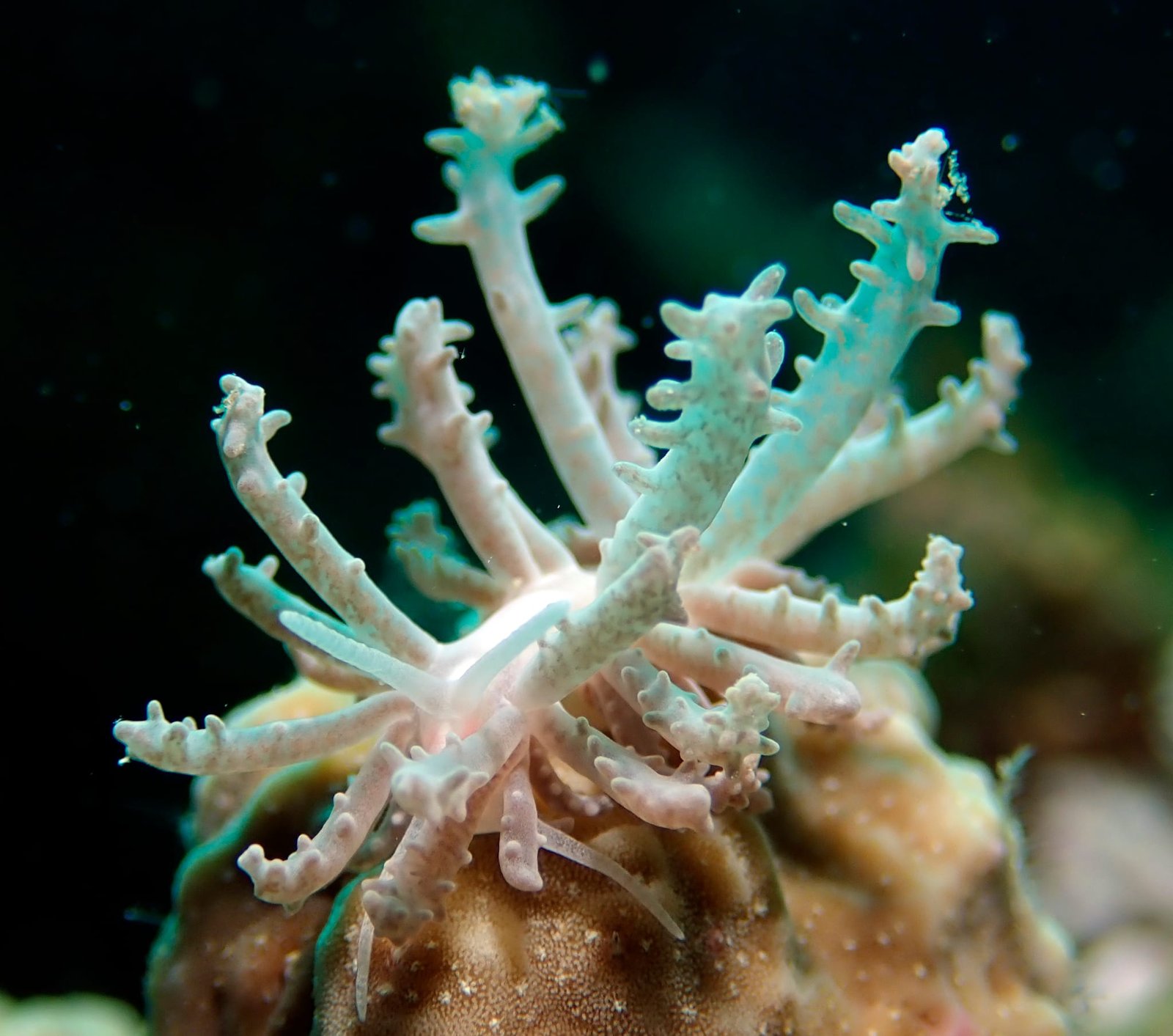
Phyllodesmium pinnatum (Moore & Gosliner, 2009) is one of the most cryptic solar-powered nudibranchs at our macro dive sites in Romblon, Philippines. Its cerata are elongate, flattened and pinnate — branching like tiny trees. This structure matches octocoral colonies almost perfectly. As a result, it is nearly invisible on its prey. It belongs to the order Nudibranchia, suborder Aeolidina, family Myrrhinidae. Furthermore, its type locality is the Philippines — described from Batangas Province. Find it on iNaturalist.
Solar Power Through Octocoral
Like all Phyllodesmium species, Phyllodesmium pinnatum retains zooxanthellae from its octocoral prey. These algae photosynthesise sunlight and provide the animal with supplementary energy. In contrast to Phyllodesmium longicirrum, which feeds on Sarcophyton, this species targets octocorals of the order Alcyonacea. Its close relatives Phyllodesmium colemani, Phyllodesmium jakobsenae and Phyllodesmium koehleri are also in our Marine Life Encyclopedia. Together they represent five different solar-powered strategies documented at Sunset Cove — the most diverse Phyllodesmium collection documented at any single dive resort in the Philippines.
Finding It at Sunset Cove
At Sunset Cove Beach & Dive Resort, our guides search octocoral colonies carefully at 3 to 25 metres depth. The pinnate cerata match coral branches almost exactly. Therefore, look for slightly irregular branch structure on a colony. Approach very slowly — it sits completely still. For underwater macro photographers in Romblon, the tree-like cerata create extraordinary close-up images. Consequently, finding all five Phyllodesmium at our dive sites is one of the great macro photography challenges at Sunset Cove.
| Order | Nudibranchs (Nudibranchia) |
|---|---|
| Suborder | Aeolidina (Aeolid Nudibranchs) |
| Family | Myrrhinidae |
| Subfamily | Phyllodesmiinae |
| Genus | Phyllodesmium |
| WoRMS AphiaID | 457930 |
| iNaturalist | 496578 |
| Size | 15–40 mm |
|---|---|
| Colour Variations | Body whitish-grey to brownish-grey. Cerata elongate, flattened and tree-like or pinnate — the most distinctive feature of this species. Zooxanthellae retained from octocoral prey and distributed through cerata — providing supplementary solar energy. Colour closely matches prey octocoral colony making it one of the most cryptic Phyllodesmium species. The pinnate ceratal structure is unique among the Phyllodesmium documented at Sunset Cove. |
| Identifying Features | Distinguished by its pinnate — feather-like or tree-like — flattened cerata, unique among Phyllodesmium at Romblon. Body whitish-grey to brownish-grey matching octocoral prey. Always found directly on octocoral colonies. Type locality is the Philippines — described from Batangas Province. Distinguished from P. longicirrum by smaller size and pinnate rather than paddle-like cerata. Distinguished from P. colemani and P. jakobsenae by octocoral prey rather than organ pipe or Xenia coral. |
| Substrate | coral |
|---|---|
| Depth Range | 3–25 m (most common: 10 m) |
| Temperature | 24–29°C |
| Primary Prey / Host | Octocorals (soft corals, order Alcyonacea) — highly cryptic on prey colonies |
| Active Time | day, night |
|---|---|
| Seasonal Presence | Year-round — dependent on presence of octocoral colonies |
| Egg Ribbon | White, coiled ribbon |
| Spawning Season | Not yet documented at SSC |
| Chemical Defence | Present |
| Aposematic Colouring | Absent |
| Camouflage Strategy | Pinnate tree-like cerata precisely mimic the structure of octocoral colonies. Body colour matches prey coral. One of the most cryptic Phyllodesmium species — nearly impossible to spot without knowing exactly what to look for. |
| Escape Response | Primary defence is exceptional camouflage on octocoral colonies. Remains motionless when threatened. Chemical deterrents from coral prey. |
-
Three new species of Phyllodesmium Ehrenberg (Gastropoda: Nudibranchia: Aeolidoidea), and a revised phylogenetic analysis
Moore, E. & Gosliner, T.M. (2009). Zootaxa 2201: 30–48