
coming
soon
coming
soon
coming
soon
coming
soon
The Largest Solar-Powered Nudibranch
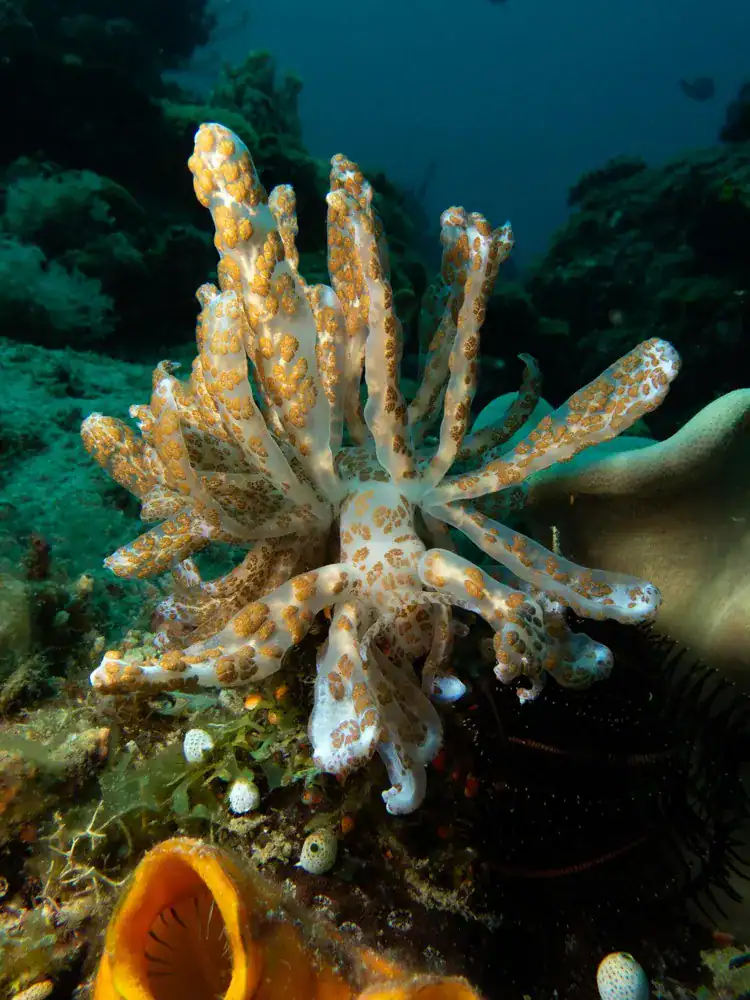
Phyllodesmium longicirrum (Bergh, 1905) is the largest aeolid nudibranch in the Indo-Pacific. It grows up to 140 mm. Divers call it the Solar-Powered Nudibranch. It belongs to the order Nudibranchia, suborder Aeolidina, family Myrrhinidae. Furthermore, zooxanthellae live inside its cerata. These algae photosynthesise sunlight and produce energy directly for the animal. As a result, it can go long periods without feeding on its prey coral. Find observations on iNaturalist.
Giant Solar Paddles
The cerata are large and flat — like solar panels. They maximise surface area for photosynthesis. In contrast to most aeolid nudibranchs, this species carries no cnidosacs. Instead, it stores diterpene chemicals from its prey as defence. It feeds on Sarcophyton trocheliophorum soft coral. Its close relatives Phyllodesmium colemani, Phyllodesmium jakobsenae and Phyllodesmium koehleri all appear in our Marine Life Encyclopedia. Together, these four species show the remarkable diversity of solar-powered nudibranchs at Romblon.
Finding It at Sunset Cove
At Sunset Cove Beach & Dive Resort, our guides search Sarcophyton soft coral colonies on sandy rubble at 5 to 30 metres depth. The animal is large and visible from a distance. However, it blends well against the coral. Therefore, check the base and underside of colonies carefully. For underwater macro photographers in Romblon, the enormous flat cerata create outstanding images. Consequently, this species ranks among the most impressive nudibranch photography subjects at our dive sites.
| Order | Nudibranchs (Nudibranchia) |
|---|---|
| Suborder | Aeolidina (Aeolid Nudibranchs) |
| Family | Myrrhinidae |
| Subfamily | Phyllodesmiinae |
| Genus | Phyllodesmium |
| WoRMS AphiaID | 548881 |
| iNaturalist | 358202 |
| Size | 60–140 mm |
|---|---|
| Colour Variations | Body translucent white to pale cream. Cerata large, flattened, leaf-like — evolved into "solar paddles" to maximise surface area for photosynthesis. Cerata typically translucent to brownish due to zooxanthellae colonies living inside. Rhinophores smooth, moderately long. Oral tentacles slender. Juveniles appear more translucent and less developed in cerata structure. |
| Identifying Features | The largest aeolid nudibranch in the Indo-Pacific — up to 140mm. Instantly recognisable by its enormous flattened leaf-like cerata which function as solar panels. Translucent body with brownish zooxanthellae visible through cerata walls. Always found on or near its prey Sarcophyton soft coral. Unlike most aeolids, lacks cnidosacs — defence relies on diterpene chemicals sequestered from its coral prey. The sheer size and distinctive cerata shape make misidentification very unlikely. |
| Substrate | coral, rubble |
|---|---|
| Depth Range | 5–30 m (most common: 12 m) |
| Temperature | 24–29°C |
| Primary Prey / Host | Sarcophyton trocheliophorum (soft coral, family Alcyoniidae) |
| Active Time | day, night |
|---|---|
| Seasonal Presence | Year-round — most reliably found near Sarcophyton soft coral colonies |
| Egg Ribbon | White, coiled ribbon |
| Spawning Season | Not yet documented at SSC |
| Chemical Defence | Present |
| Aposematic Colouring | Absent |
| Camouflage Strategy | Zooxanthellae housed in cerata provide brownish colouration that blends with Sarcophyton soft coral colonies. Body transparency also aids concealment. |
| Escape Response | When threatened, drops cerata which continue to writhe (autotomy). Relies primarily on chemical deterrents — diterpene compounds sequestered from Sarcophyton coral prey. |
-
Further studies on the taxonomy and biology of the octocoral-feeding genus Phyllodesmium Ehrenberg, 1831 (Nudibranchia: Aeolidoidea)
Rudman, W.B. (1991). Journal of Molluscan Studies 57(2): 167–203